What Helps Joint Stiffness After 50? Why It Happens and What Actually Works
You wake up, swing your legs out of bed, and for the first several steps your knees or hips feel like they belong to someone twenty years older than you actually feel. Fifteen minutes later, walking normally, it’s mostly gone. If that pattern sounds familiar, you’re describing one of the most common — and most misunderstood — experiences of getting older: age-related joint stiffness.
This guide explains what’s actually happening inside a stiff joint, why certain situations (like mornings, or getting up after sitting) make it so much worse, what genuinely helps, and — just as importantly — which patterns are worth bringing to a doctor rather than managing on your own.
Joint stiffness after 50 is usually caused by reduced synovial fluid production, gradual cartilage thinning, and stiffer connective tissue — not injury or disease in most cases. It’s typically worse after periods of inactivity (overnight, or after sitting) because joints rely on movement to keep lubricating fluid circulating. Gentle movement, heat, consistent activity, and maintaining a healthy weight are the most evidence-supported ways to reduce it. Stiffness that doesn’t ease within 30-45 minutes, or that comes with swelling, warmth, or redness, warrants a medical evaluation.
What’s Actually Happening Inside a Stiff Joint
A healthy joint depends on a thin layer of cartilage cushioning the bones, and a small amount of synovial fluid — a slippery, egg-white-like substance — that lubricates the joint and delivers nutrients to cartilage, which has almost no direct blood supply of its own. Both of these systems change gradually with age:
- Synovial fluid production slows down. The synovial membrane produces less fluid, and the fluid that is produced becomes slightly thicker and less effective at lubrication. This is a major reason joints feel “stiff” rather than simply “weak.”
- Cartilage thins and loses some elasticity. Decades of normal use, combined with cartilage’s very limited ability to repair itself, mean there’s simply less cushioning between bones than there was at 25 or 30.
- Connective tissue (tendons and ligaments) becomes less elastic. Collagen structure changes with age, and tissues that once stretched easily now have a narrower comfortable range.
- Surrounding muscles often do less work than they used to. Muscle loss (sarcopenia) means joints frequently absorb more direct mechanical load, which can make normal cartilage wear feel more noticeable.
None of this means something has gone wrong. It means the joint’s support systems have gradually become less efficient — which is exactly why movement, strength, and lubrication-friendly habits make such a measurable difference.
Why Mornings Are the Worst: The Overnight Stiffness Pattern
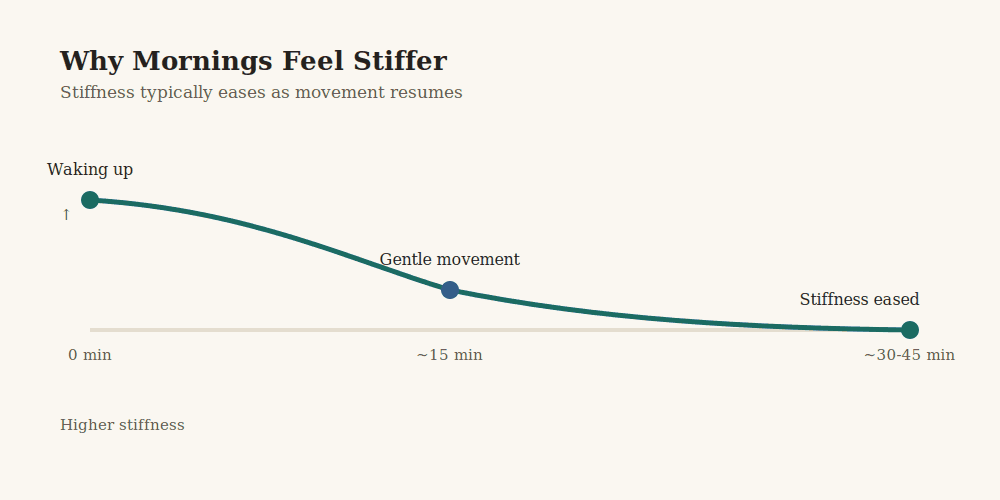
Synovial fluid needs movement to circulate and do its job well — think of it less like oil sitting in a reservoir and more like a substance that only lubricates properly once the joint has been moving for a few minutes. Overnight, joints go seven or eight hours with essentially no movement. When you first get up, you’re moving a joint that’s had its lubrication system idling all night, on tissues that stiffened slightly during that stillness.
This is why morning stiffness that eases within about 30 to 45 minutes of being up and moving is considered a normal, common pattern rather than a red flag. Stiffness that lasts significantly longer than that — especially over an hour — is one of the patterns doctors specifically ask about when evaluating for inflammatory joint conditions like rheumatoid arthritis, discussed further below.
Knee Joint Stiffness After Sitting: Why It Happens and What Helps
A specific version of this same pattern shows up constantly in people over 50: knees (and sometimes hips) that feel stiff or “locked up” for the first several steps after standing up from a chair, a car seat, or a couch — especially after sitting for 30 minutes or more.
The mechanism is the same overnight-stiffness principle, just on a shorter timescale. Sitting, particularly with knees bent, briefly reduces circulation of synovial fluid and allows surrounding soft tissue to tighten slightly. Add a longer flight, a movie, or a long work-from-home stretch at a desk, and that first stand-up-and-walk moment can feel noticeably worse than it did earlier in the day.
A few specific things help this exact pattern:
- Change position periodically. Standing up, shifting position, or briefly bending and straightening the knee every 30-45 minutes during long sitting periods keeps fluid circulating and prevents the “cold start” effect.
- Avoid fully locking the knee straight while seated for long periods — a slightly bent, relaxed position tends to feel better on standing than a fully extended one.
- Stand up deliberately, not suddenly. Pause seated at the edge of the chair, then rise slowly, giving the joint a moment to “wake up” before bearing full weight.
- A few gentle knee bends while holding onto a stable surface immediately after standing can shorten how long that “locked up” feeling lasts.
- Choose supportive seating when possible. Chairs that are too low force knees into a more acute angle for longer, which tends to worsen this effect.
This pattern, while extremely common, is also one of the most search-and-worry-inducing symptoms people bring up — largely because it can feel dramatic in the moment (a knee that briefly won’t move normally) even though it’s usually a benign, mechanical effect rather than a sign of joint damage.
Common Causes of Joint Stiffness After 50
Most joint stiffness after 50 falls into one of a few categories. This table is educational, not diagnostic — only a healthcare provider can tell you which applies to your specific situation.
| Likely cause | Typical pattern | Distinguishing features |
|---|---|---|
| Normal age-related changes | Worse in the morning or after sitting, eases within ~30-45 minutes, improves with movement | No significant swelling, symmetrical mild stiffness, gradually developed over years |
| Osteoarthritis | Stiffness plus a dull ache that tends to worsen with heavy use later in the day | Often affects weight-bearing joints (knees, hips) or hands; may include a grinding sensation |
| Rheumatoid arthritis or other inflammatory conditions | Morning stiffness lasting over an hour, often affecting joints symmetrically on both sides of the body | May include visible swelling, warmth, fatigue, or general feeling of being unwell |
| Tendinitis or localized overuse | Stiffness and pain concentrated at one specific spot, often tied to a repeated activity | Usually one joint or tendon area rather than widespread; often has a clear onset tied to activity |
| Gout | Sudden, severe pain and swelling, often starting in the big toe | Rapid onset (can develop overnight), intense redness and warmth, usually one joint at a time |
What Actually Helps Joint Stiffness
Consistent, moderate movement
This is the single most evidence-supported habit for reducing everyday joint stiffness. Joints are designed to move, and inactivity worsens nearly every mechanism behind stiffness — reduced fluid circulation, weaker supporting muscles, and stiffer connective tissue all get worse, not better, with a sedentary routine. See our full guide on low-impact exercise for joint pain for specific, safe ways to start.
Heat before activity, and sometimes cold after
A warm shower, heating pad, or warm bath before activity can loosen stiff tissue and make the first few minutes of movement more comfortable. Cold packs are generally more useful after activity if a joint feels swollen or irritated rather than simply stiff.
Maintaining a healthy weight
Every extra pound of body weight translates into several pounds of additional force on weight-bearing joints like knees during walking. Even modest, sustainable weight management can measurably reduce joint stress over time.
Gentle stretching, especially before getting out of bed
Simple ankle circles, gentle knee bends, and slow stretches while still lying down can shorten how long morning stiffness lasts before you’re even up and moving.
Staying hydrated
Synovial fluid is largely water-based. While hydration alone won’t reverse structural joint changes, chronic dehydration doesn’t help the body’s lubrication systems function at their best.
Prioritizing sleep quality
Poor sleep is associated with increased pain sensitivity and inflammation markers. Consistent, adequate sleep is an underrated part of joint comfort that’s easy to overlook.
Does Anything From a Bottle Actually Help With Stiffness?
Ingredients like glucosamine, chondroitin, and hyaluronic acid are widely marketed for joint stiffness and comfort, and the honest picture is more nuanced than most product pages suggest — some ingredients show modest benefit in quality research for certain people, while marketing claims frequently go further than the evidence supports. We break this down ingredient by ingredient, including what’s genuinely established versus what remains uncertain, in Glucosamine, Chondroitin & Hyaluronic Acid: What the Evidence Says.
“Inflammaging”: The Slow-Burning Background Factor
Researchers use the term “inflammaging” to describe a low-grade, chronic increase in background inflammation that tends to accompany normal aging, distinct from the acute inflammation of an injury or flare. This slow-burning inflammation is thought to contribute to gradual cartilage changes and can make joints generally more reactive to overuse or inactivity. It’s influenced by factors like sleep quality, stress, body weight, and overall diet pattern — which is part of why lifestyle habits show up so consistently in joint stiffness research, not just joint-specific treatments.
How Doctors Typically Narrow Down the Cause
If joint stiffness is significant enough to bring to a doctor, the evaluation usually starts with a detailed history (when it happens, how long it lasts, what makes it better or worse) and a physical exam checking for swelling, warmth, range of motion, and symmetry. Depending on those findings, a doctor may order blood tests (useful for ruling in or out inflammatory conditions like rheumatoid arthritis) or imaging like an X-ray or MRI to assess cartilage and joint structure directly. Most routine, age-related stiffness doesn’t require this level of workup — it’s reserved for cases with the red-flag patterns described below, or stiffness that isn’t responding to the usual self-care approaches.
A Note on Over-the-Counter Pain Relief
Over-the-counter options like acetaminophen or NSAIDs (such as ibuprofen or naproxen) are commonly used for joint discomfort, and can be reasonable for occasional use. However, NSAIDs in particular carry real risks with regular, long-term use — including effects on the stomach, kidneys, and cardiovascular system — that are more relevant the longer and more frequently they’re used. Anyone reaching for over-the-counter pain relief regularly (more than occasionally) should discuss this with a doctor or pharmacist rather than treating it as a permanent, no-downside solution.
When Joint Stiffness Is a Sign of Something More
Most joint stiffness after 50 is manageable and benign, but certain patterns are worth bringing to a doctor rather than managing alone:
- Morning stiffness that consistently lasts longer than an hour
- Visible swelling, warmth, or redness around a joint
- Stiffness or pain that’s gotten noticeably worse over a period of weeks
- A joint that locks, catches, or gives way
- Stiffness affecting the same joints on both sides of the body, especially with fatigue or feeling generally unwell
- Pain that wakes you up at night or is present at rest, not just with movement
- Sudden, severe onset of pain and swelling, particularly in a single joint like a toe or ankle
None of this is meant to cause alarm — the large majority of joint stiffness after 50 fits the normal, manageable pattern described throughout this guide. But these specific patterns fall outside “typical aging” and are worth a professional evaluation rather than self-management.
Does Stiffness Feel Different in Different Joints?
| Joint | Common stiffness pattern after 50 |
|---|---|
| Knees | Often the most noticeable after sitting or first thing in the morning; may include a grinding or clicking sensation with movement |
| Hips | Frequently felt as tightness affecting stride length or difficulty putting on shoes/socks, rather than sharp pain |
| Hands and fingers | Morning stiffness is very common; may affect grip strength before “warming up,” especially in colder weather |
| Shoulders | Often shows up as reduced overhead reach or discomfort reaching behind the back, sometimes tied to reduced daily use of that range of motion |
| Lower back | Commonly worse after prolonged sitting or first thing in the morning, closely tied to core and hip muscle strength |
Simple Stretches That Help Most People
- Gentle knee-to-chest stretch (lying down): eases lower back and hip stiffness, hold 20-30 seconds per side.
- Wrist and finger stretches: gently extend fingers back with the opposite hand, hold briefly; helpful for morning hand stiffness.
- Cat-cow spinal movement (on hands and knees, or seated): gentle alternating spinal flexion and extension, especially useful before getting up in the morning.
- Doorway chest and shoulder stretch: standing in a doorway with forearms on the frame, gently leaning forward; helps counter the forward-rounded posture that limits shoulder mobility over time.
- Ankle circles and calf raises: quick, low-effort movements that support ankle and lower-leg circulation, useful first thing in the morning or after sitting.
Most joint stiffness after 50 comes down to reduced synovial fluid circulation, gradual cartilage changes, and stiffer connective tissue — all of which respond well to consistent movement, healthy weight management, and simple daily habits like stretching before getting out of bed. The knee-stiffness-after-sitting pattern specifically is almost always mechanical, not damage-related. Stiffness lasting over 45 minutes, or accompanied by swelling, warmth, or worsening pain, deserves a medical evaluation rather than continued self-management.
Frequently Asked Questions
Why are my joints so stiff when I wake up?
Overnight, synovial fluid isn’t circulated by movement, and connective tissue stiffens slightly during hours of stillness. This “cold start” effect is one of the most universal and normal patterns of aging joints, and typically resolves within 30-45 minutes of activity.
Why do my knees feel stiff after sitting for a while?
The same reduced-circulation effect that causes morning stiffness happens on a shorter timescale after any extended period of sitting, especially with knees bent. Changing position periodically during long sitting sessions and standing up gradually rather than suddenly both help.
What helps joint stiffness fastest, in the moment?
Heat (a warm shower or heating pad) combined with gentle, gradual movement tends to work faster than either alone. Avoid sudden, forceful movement on a cold, stiff joint — ease into range of motion gradually.
Is joint stiffness after 50 always arthritis?
No. Ordinary age-related changes to cartilage, synovial fluid, and connective tissue cause a great deal of stiffness without any arthritis diagnosis. Arthritis is one possible cause among several, and it typically comes with additional distinguishing features like the patterns described above.
Can losing weight actually reduce joint stiffness?
Yes, particularly for weight-bearing joints like knees and hips. Reducing the mechanical load on a joint reduces both stiffness and discomfort for many people, even with modest, sustainable weight changes.
Does cracking or popping in a joint mean something is wrong?
Occasional painless popping or cracking (sometimes called crepitus) is common and usually harmless, often caused by small gas bubbles in joint fluid or tendons moving slightly over bone. It becomes worth mentioning to a doctor if it’s accompanied by pain, swelling, or a noticeable change in how the joint feels or functions.
Does joint stiffness get progressively worse every year, or can it plateau?
It’s not a strictly linear decline for most people. While some underlying changes (like cartilage thinning) are gradual and ongoing, how much stiffness actually affects daily life depends heavily on modifiable factors — activity level, strength, weight, and sleep among them. Many people who improve these factors see their day-to-day stiffness plateau or even improve, rather than steadily worsening year over year.
Does stress make joint stiffness worse?
It can, indirectly. Stress is associated with increased muscle tension and can worsen sleep quality, both of which can make stiffness feel more pronounced even without any underlying change in the joint itself. Stress-management habits — even simple ones like consistent sleep and short daily walks — are a reasonable, low-cost part of an overall joint comfort routine.