Does Glucosamine Chondroitin Work? What the Evidence Shows
Ingredient Evidence Level: ModerateFew joint health ingredients are more widely marketed — or more genuinely debated in medical research — than glucosamine, chondroitin, and hyaluronic acid. Walk down any pharmacy aisle and you’ll find dozens of products built around these three ingredients, often with confident claims about “rebuilding cartilage” or “restoring joint comfort.” The actual research is more complicated, more interesting, and more useful to understand than any single product’s marketing copy.
This guide separates what quality research actually shows for each ingredient from what remains genuinely uncertain, and explains an important distinction we apply to every product review on this site: an ingredient having real evidence behind it does not automatically mean any specific branded product delivers the same results. Dose, formulation, ingredient source, and manufacturing quality all affect whether a product can plausibly deliver what the underlying research suggests.
Research on glucosamine and chondroitin for joint health is mixed rather than uniformly positive or negative. Some large trials and reviews have found modest benefit for certain people — particularly those with moderate-to-severe osteoarthritis symptoms — while others found no significant difference from placebo. Chondroitin has some evidence for modestly slowing cartilage space narrowing over time. Oral hyaluronic acid has less robust evidence than injectable forms, though some newer, more bioavailable formulations show promising early results. None of these ingredients are established to reverse existing joint damage, and evidence quality varies significantly by specific formulation and dose.
Why This Ingredient Group Gets So Much Research Attention
Glucosamine and chondroitin are naturally occurring components of cartilage. The theory behind supplementing with them is straightforward: if cartilage is breaking down faster than the body can repair it, providing the raw materials might support repair or at least slow further loss. Hyaluronic acid, meanwhile, is a key component of synovial fluid itself, and the idea behind hyaluronic acid supplementation is supporting the joint’s natural lubrication system rather than cartilage directly.
This is a genuinely reasonable scientific premise — which is part of why these ingredients have been studied so extensively, including in large, publicly-funded clinical trials, rather than only in industry-funded research.
Glucosamine: What Research Shows
Glucosamine research has produced some of the most-cited mixed results in the entire supplement research space. A large, NIH-funded trial known as GAIT (the Glucosamine/chondroitin Arthritis Intervention Trial) found that, for the overall study population, glucosamine and chondroitin — alone or combined — did not significantly outperform placebo on the primary outcome measure. However, a subgroup of participants with moderate-to-severe knee pain did show meaningfully better results with the glucosamine-chondroitin combination than with placebo, a finding that’s been referenced in joint health research since.
Subsequent research and reviews have added nuance rather than resolving the debate entirely. Some studies suggest the specific form matters: glucosamine sulfate has shown more consistent positive results in European research than glucosamine hydrochloride, which is the more common (and cheaper) form used in many U.S. supplements. This formulation difference is rarely disclosed clearly on product labels, which makes it one of the more important — and most overlooked — details when evaluating any specific glucosamine product.
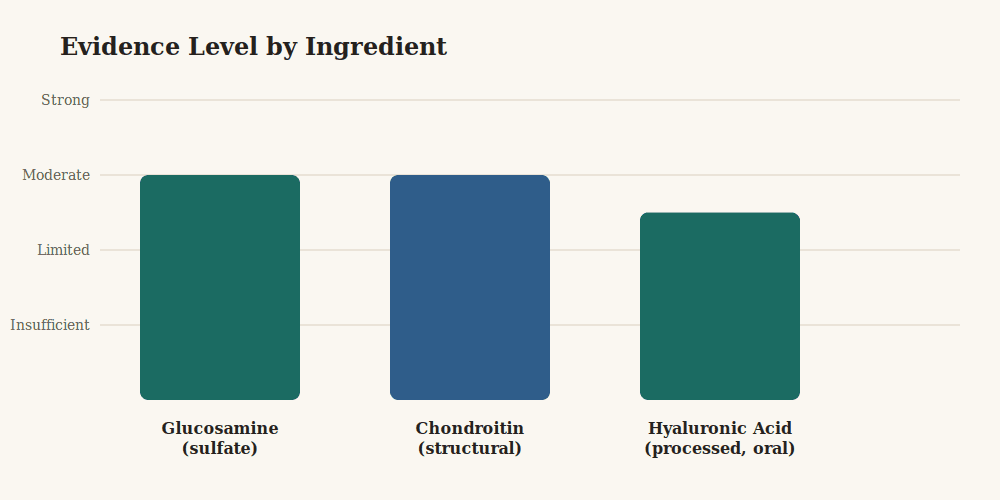
Evidence Level for glucosamine (general joint comfort in osteoarthritis-related symptoms): Moderate, with meaningfully stronger evidence for glucosamine sulfate specifically than for glucosamine hydrochloride, and stronger results in people with moderate-to-severe symptoms than mild ones.
Chondroitin: What Research Shows
Chondroitin has been studied both for symptom relief and for a more structural question: whether it can slow the narrowing of joint space (a marker of cartilage loss) visible on X-ray over time. Several trials and systematic reviews have found modest evidence supporting chondroitin for this structural outcome, alongside more mixed results for day-to-day pain and stiffness relief, which vary depending on formulation purity and study design.
Chondroitin sourced and manufactured to pharmaceutical-grade purity standards has generally performed more consistently in research than lower-purity forms, and purity varies considerably between manufacturers — another detail that matters more than most marketing acknowledges.
Evidence Level for chondroitin (symptom relief): Limited to Moderate, depending on formulation purity. Evidence Level for chondroitin (slowing structural progression): Moderate, based on multiple trials showing modest effects on joint space narrowing.
Hyaluronic Acid: What Research Shows
Hyaluronic acid is well-established as an effective treatment when injected directly into a joint by a physician — this is a standard, FDA-cleared procedure for certain osteoarthritis cases. Oral hyaluronic acid supplementation is a newer and less extensively studied approach, based on the idea that ingested hyaluronic acid can still meaningfully support the body’s own synovial fluid production.
Traditional oral hyaluronic acid has faced a real scientific challenge: it’s a large molecule, and questions about how well it survives digestion and reaches joint tissue have limited how strongly researchers can draw conclusions from older studies. More recent research has focused on lower-molecular-weight and specially processed hyaluronic acid formulations designed to improve absorption, with some smaller studies showing promising results for joint comfort — though this body of research is considerably smaller than the decades of glucosamine and chondroitin research.
Evidence Level for oral hyaluronic acid (general formulations): Limited. Evidence Level for specially processed, higher-absorption hyaluronic acid formulations: Limited to Moderate, reflecting a smaller but growing body of more favorable early research that has not yet reached the scale or consistency of the longer-studied ingredients above.
Comparing the Three Ingredients
| Ingredient | Primary role | Strongest evidence for | Evidence Level |
|---|---|---|---|
| Glucosamine (sulfate form) | Cartilage-building raw material | Symptom relief in moderate-to-severe osteoarthritis | Moderate |
| Glucosamine (hydrochloride form) | Cartilage-building raw material | Less consistent than sulfate form in comparative research | Limited to Moderate |
| Chondroitin (pharmaceutical-grade) | Cartilage structure support | Slowing joint space narrowing over time | Moderate |
| Hyaluronic acid (specially processed, oral) | Synovial fluid / lubrication support | Early, smaller-scale joint comfort studies | Limited to Moderate |
What This Evidence Does Not Establish
It’s worth being explicit about the limits of this research, because marketing rarely is:
- No form of glucosamine, chondroitin, or oral hyaluronic acid is established to reverse existing cartilage damage or “regrow” cartilage.
- Results vary meaningfully by individual — some people report noticeable benefit, others report little to none, and research reflects this same variability at the population level.
- Ingredient-level evidence describes the ingredient in the doses, forms, and durations actually studied — it does not automatically transfer to every commercial product containing that ingredient, especially at different doses or in combination with other unstudied ingredients.
- Benefits, where they occur, generally take weeks to months of consistent use to become noticeable, consistent with how cartilage and connective tissue change slowly.
- Supplements are not a substitute for the foundational, well-established approaches to joint comfort — see our guides on what helps joint stiffness after 50 and low-impact exercises for joint pain for the movement and lifestyle side of the picture.
Why Ingredient Evidence Doesn’t Automatically Validate a Specific Product
This is the single most important distinction in this guide, and it’s the standard we apply to every product review on this site. A supplement combining glucosamine, chondroitin, and hyaluronic acid can legitimately reference decades of ingredient research — while the specific product’s dose, ingredient form, and combination with other unstudied ingredients may or may not reflect the conditions under which that research was actually conducted.
When we evaluate a specific product, we look at several things separately from the ingredient science itself: whether the doses used match those studied in research, whether the specific ingredient form (like glucosamine sulfate versus hydrochloride) is disclosed, whether proprietary blends obscure individual ingredient amounts, and whether the manufacturer’s own marketing claims stay within what the evidence actually supports or overstate it. Our Joint Genesis review applies exactly this framework to a specific product built around several of the ingredients discussed here, including its featured branded hyaluronic acid ingredient.
Collagen vs. Glucosamine and Chondroitin
Collagen supplements (particularly hydrolyzed collagen and collagen peptides) work through a different, related mechanism — providing amino acid building blocks used in cartilage and connective tissue, rather than glucosamine and chondroitin’s more direct cartilage-component approach. Some research suggests collagen peptides may support joint comfort through this pathway, though the research base, while growing, remains smaller than the decades of glucosamine and chondroitin study. These aren’t competing options so much as different mechanisms — some joint supplement formulations combine several of these ingredient categories rather than relying on just one.
How These Ingredients Are Typically Dosed in Research
One of the most useful things to check on any product label is whether the dose matches what’s actually been studied. This doesn’t guarantee a product works, but a dose far below the studied range makes it much less likely to reproduce study results.
| Ingredient | Typical dose used in research | What to check on a label |
|---|---|---|
| Glucosamine sulfate | Commonly 1,500mg per day, often in a single dose | Whether it’s specifically labeled “sulfate” rather than just “glucosamine” |
| Chondroitin sulfate | Commonly 800-1,200mg per day | Purity/pharmaceutical-grade sourcing, since lower-purity chondroitin has performed less consistently |
| Hyaluronic acid (oral) | Varies widely by formulation, commonly 80-200mg for specially processed forms | Whether it’s a specific branded/processed form with its own research, versus generic “hyaluronic acid” with no disclosed processing |
Reading a Joint Supplement Label Like an Editor
A few habits make it much easier to evaluate any joint supplement label with a clear eye rather than being swayed by marketing language alone:
- Look for “proprietary blend” language. This means individual ingredient amounts within that blend aren’t disclosed, which makes it impossible to compare the product’s dosing against research.
- Check ingredient form, not just ingredient name. “Glucosamine” alone doesn’t tell you if it’s the sulfate or hydrochloride form, and the difference matters for the evidence discussed above.
- Be skeptical of specific, dramatic multiplier claims (like “10x” or “300% more effective”) unless the source of that figure is clearly disclosed and independently verifiable, rather than only appearing in the manufacturer’s own marketing.
- Notice the timeline being promised. Legitimate research on these ingredients generally shows gradual change over 8-12 weeks or longer — claims of rapid, dramatic relief within days are inconsistent with how these ingredients are understood to work.
MSM and Other Adjacent Ingredients
Methylsulfonylmethane (MSM) is another ingredient frequently included alongside glucosamine and chondroitin in joint supplement blends. Research on MSM specifically for joint comfort is smaller in scale than the glucosamine and chondroitin research base, with some studies suggesting modest benefit for pain and physical function, though larger, more rigorous trials are still limited. It’s reasonable to view MSM similarly to hyaluronic acid in this guide — plausible, backed by some research, but with a less extensive evidence base than glucosamine or chondroitin.
Safety and Who Should Be Cautious
Glucosamine, chondroitin, and hyaluronic acid are generally well-tolerated, with mild digestive upset being the most commonly reported side effect. A few specific caution points are worth knowing:
- Shellfish allergy: Some glucosamine is derived from shellfish shells. People with shellfish allergies should choose products explicitly labeled shellfish-free or plant-based, and check with a pharmacist if unsure.
- Blood thinners: Glucosamine and chondroitin may have a mild interaction with blood-thinning medications like warfarin in some people. Anyone on blood thinners should discuss any new joint supplement with their doctor first.
- Diabetes: Some early research raised questions about glucosamine’s effect on blood sugar; while more recent evidence is reassuring, people managing diabetes should mention any new supplement to their care team.
- Pregnancy and breastfeeding: Evidence is insufficient to establish safety in pregnancy or breastfeeding, and these ingredients are generally not recommended without medical guidance in that context.
What's good
- Decades of research, including large publicly-funded trials, on glucosamine and chondroitin specifically
- Chondroitin has genuine evidence for slowing structural joint changes, not just symptoms
- Generally well-tolerated with a mild safety profile for most adults
- Newer hyaluronic acid formulations show promising early results
Limitations
- Evidence is mixed and formulation-dependent, not a uniform 'yes it works'
- Benefits, where present, are typically modest rather than dramatic
- Results vary significantly between individuals
- Product-level quality (dose, form, purity) is not guaranteed by ingredient-level research
Other Frequently Marketed Joint Ingredients
Beyond the three ingredients this guide focuses on, a few others show up regularly in joint supplement formulas and are worth a brief, honest note:
- Turmeric/curcumin — has a reasonably solid research base for general inflammatory response, though poor natural absorption means formulation (such as combining with black pepper extract) matters significantly for whether a given dose is meaningfully bioavailable.
- Green-lipped mussel extract — has some supportive research for joint comfort, though the evidence base is considerably smaller than glucosamine or chondroitin.
- Collagen peptides — discussed in more detail above; a different mechanism than glucosamine/chondroitin with a growing but still developing research base.
- MSM — discussed above; plausible with some supporting research, but less extensively studied than the primary ingredients in this guide.
A Practical Way to Compare Cost Against Evidence
One useful exercise before buying any joint supplement: calculate the cost per day at the studied dose (not just the total bottle price), and compare that against how strong the evidence actually is for that specific ingredient and form. A product with strong, well-replicated evidence at a fair cost per studied dose is a more defensible choice than a more expensive product built around a less-studied proprietary blend, regardless of how confident the marketing sounds. This simple math is one of the most effective ways to cut through supplement marketing generally, not just in the joint health category.
Glucosamine, chondroitin, and hyaluronic acid all have real, ingredient-level research behind them — but that research is genuinely mixed, formulation-dependent, and generally shows modest rather than dramatic benefits. The most important habit when evaluating any joint supplement is separating what the ingredient research actually supports from what a specific product’s marketing claims, since dose, ingredient form, and manufacturing quality all affect whether a product can realistically deliver what the underlying science suggests.
Frequently Asked Questions
Does glucosamine chondroitin actually work for joint pain?
The research is mixed rather than a clear yes or no. Large trials have found modest benefit for some people, particularly those with moderate-to-severe symptoms, while others found no significant advantage over placebo. Formulation matters — glucosamine sulfate has more consistent supporting research than glucosamine hydrochloride.
What is glucosamine chondroitin actually made of?
Glucosamine is an amino sugar naturally found in cartilage and often derived from shellfish shells (or made synthetically/plant-based for allergy-friendly versions). Chondroitin is a complex carbohydrate also naturally present in cartilage, typically derived from animal cartilage sources.
How long does it take to notice a difference from these supplements?
Most research showing benefit involved consistent use over 8-12 weeks or longer, consistent with how slowly cartilage and connective tissue change. Products promising fast, dramatic results within days should be viewed skeptically.
Is hyaluronic acid better than glucosamine and chondroitin?
They’re not directly comparable — hyaluronic acid primarily supports joint lubrication, while glucosamine and chondroitin relate more to cartilage structure. Some products combine multiple ingredient categories rather than relying on just one, and the “better” choice depends on what a person’s main joint concern actually is.
Should I stop taking a joint supplement if I don’t notice a difference right away?
Most research protocols used at least 8-12 weeks before evaluating results, so a short trial period may not be long enough to judge effectiveness. That said, if there’s no noticeable difference after a full 8-12 week trial at the studied dose, it’s reasonable to reconsider whether that specific product or ingredient is right for you.
Can I take glucosamine, chondroitin, and hyaluronic acid together?
Many products combine two or more of these ingredients, and there’s no strong evidence of harmful interaction between them at typical doses. The bigger question is usually whether the combined product discloses individual doses clearly enough to know whether each ingredient is present at a level consistent with supporting research, rather than whether combining them is inherently risky.