Joint & Mobility Wellness After 50
If your knees announce themselves before the weather does, or you’ve noticed your hands take longer to loosen up in the morning than they used to, you’re not imagining it — and you’re not alone. Somewhere around 50, joints and the systems that support them (cartilage, muscle, tendons, balance) start changing in ways that are normal, predictable, and — importantly — largely manageable.
This guide is the starting point for everything The Health Primer covers on joint and mobility wellness. It won’t try to sell you on a single fix, because there isn’t one. Instead, it lays out what’s actually happening in an aging joint, what genuinely helps, what the evidence does and doesn’t support, and where to go next depending on what you’re dealing with.
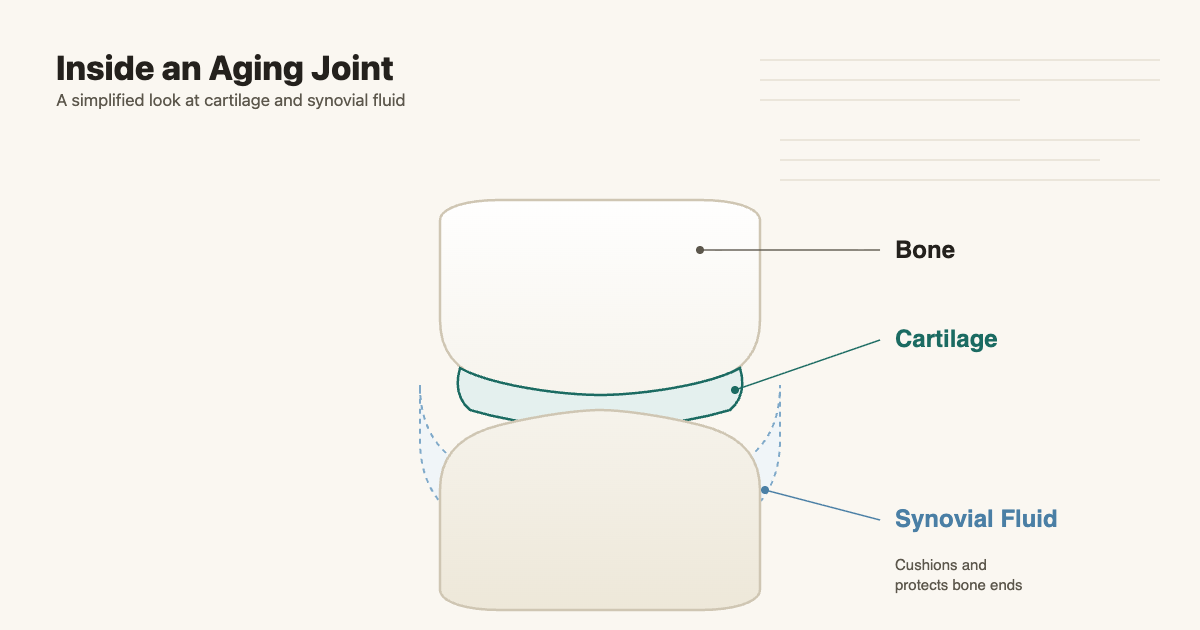
After 50, joint stiffness and reduced mobility are usually driven by a combination of thinning cartilage, less synovial fluid, natural muscle loss (sarcopenia), and stiffer connective tissue — not necessarily arthritis or injury. Movement, targeted strength work, and in some cases evidence-supported ingredients can meaningfully improve comfort and function. Persistent swelling, sudden onset pain, or joint pain that limits daily activity is worth a medical evaluation rather than self-management alone.
How Mobility Changes After 50 (What’s Actually Normal)
Not every ache is a warning sign, and not every stiff morning means something is wrong. Several separate, well-documented processes contribute to how joints and movement feel differently after 50:
| What changes | Why it happens | What it usually feels like |
|---|---|---|
| Cartilage thins gradually | Cartilage has very limited blood supply and slow natural turnover, so decades of use outpace repair | A duller, less “cushioned” feeling in weight-bearing joints like knees and hips |
| Synovial fluid production declines | The joint lining produces less of the fluid that lubricates and nourishes cartilage | Morning stiffness, a “needs warming up” sensation before joints move freely |
| Muscle mass and strength decline (sarcopenia) | Natural age-related loss of muscle fibers, accelerated by inactivity | Joints absorb more direct load because supporting muscles do less of the work |
| Tendons and ligaments lose elasticity | Collagen structure changes and hydration decreases with age | Reduced range of motion, a tighter feeling during stretching or first movement |
| Balance and proprioception decline | Nerve signaling from joints and inner-ear balance systems slows slightly | Feeling less steady on uneven ground or when changing direction quickly |
These changes happen on their own clock for everyone — genetics, past injuries, weight, activity level, and overall health all speed them up or slow them down. That’s the encouraging part: because activity level and strength are two of the biggest levers, they’re also two of the most controllable.
Joint Stiffness and Comfort
Stiffness is usually the first thing people notice, often before they’d describe it as “pain.” It tends to show up in predictable patterns: worse in the morning, worse after sitting for a while, and better once you’ve been moving for ten or fifteen minutes. Understanding why stiffness happens — and which patterns are ordinary versus worth a doctor’s attention — makes it much easier to respond to sensibly instead of anxiously.
Why Joints Stiffen With Age (And What Actually Helps) covers this in full: the mechanics behind morning stiffness, why sitting makes it worse, what genuinely eases it in the moment, and the specific signs that mean it’s time to talk to a doctor rather than wait it out.
Movement, Exercise, and Building Strength Safely
The instinct to protect a stiff or achy joint by moving it less is understandable — and usually counterproductive. Muscles that support a joint need regular, appropriately-loaded activity to stay strong, and joints themselves rely on movement to keep synovial fluid circulating. The goal isn’t to push through pain; it’s to find the right type and amount of movement for where you are right now.
Low-Impact Exercises for Joint Pain After 50 walks through exactly which movements are safe to start with, how to build up gradually, and specific routines for people managing knee, hip, or general joint discomfort — including a hip-mobility-focused routine that’s often overlooked in generic senior fitness advice.
Joint Supplements and Ingredient Evidence
Search “joint supplement” and you’ll find hundreds of products, many making similar claims about glucosamine, chondroitin, hyaluronic acid, or collagen. The honest answer is that the evidence for these ingredients is mixed and ingredient-specific — some show modest, real benefit in clinical research, others show benefit mainly for certain symptoms or certain people, and marketing language routinely overstates what any single study actually found.
Glucosamine, Chondroitin & Hyaluronic Acid: What the Evidence Says breaks down what research actually supports for each ingredient, where the evidence gets weaker, and — critically — why an ingredient having decent evidence behind it doesn’t automatically mean any specific branded product delivers the same results.
Mobility Aids Worth Knowing About
Mobility aids carry an unfair stigma — many people delay using a cane or walking poles out of pride, well past the point where one would genuinely help. A properly sized cane can reduce load on a painful knee or hip by a meaningful percentage with every step. Some aids worth knowing about, regardless of whether you use them daily or only in specific situations:
- A properly fitted cane — held on the side opposite the affected joint, with the handle at wrist height when your arm hangs naturally
- Trekking or walking poles — useful for longer walks or uneven terrain, and less stigmatized than a single cane for many people
- Grab bars in the bathroom — one of the highest-value, lowest-cost additions for fall prevention, especially near the tub, shower, and toilet
- Supportive, well-fitted footwear — shoes with good arch support and a stable sole reduce joint strain far more than most people expect
- Jar openers, long-handled reachers, and shower chairs — small aids that reduce awkward joint positions during daily tasks
Fall Prevention Basics
Falls are one of the most serious risks tied to reduced mobility after 50, and joint stiffness, muscle weakness, and balance changes all contribute to fall risk together. A few habits meaningfully reduce that risk:
- Clear walkways of loose rugs, cords, and clutter, and improve lighting in hallways and stairs
- Include balance-specific exercise (not just strength or cardio) in a weekly routine
- Have vision checked annually — uncorrected vision changes are an underrated fall risk factor
- Review medications with a doctor or pharmacist periodically, since some combinations affect balance or cause dizziness
- Use grab bars and non-slip mats in the bathroom, one of the most common fall locations at home
Does Weather Really Affect Joint Pain?
It’s one of the most common claims about aging joints — “I can feel a storm coming in my knees” — and it’s more grounded in real physiology than many people assume, even though the science isn’t fully settled. Some research points to barometric pressure changes subtly affecting pressure inside joints, particularly ones already affected by osteoarthritis, while other studies have failed to find a consistent link. Cold weather also tends to make people less active and can make muscles and connective tissue feel tighter, which may compound the perceived effect independent of pressure changes themselves. The practical takeaway either way is the same: staying warm, staying active even in colder months, and not assuming a weather-related flare means something has worsened structurally are all reasonable responses.
Sleep and Joint Recovery
Sleep is one of the most overlooked factors in joint comfort. Deep sleep is when the body carries out much of its tissue repair and manages inflammation, and poor or insufficient sleep is consistently associated with increased next-day pain sensitivity. A supportive mattress, a pillow between the knees for side sleepers with hip or knee discomfort, and consistent sleep and wake times are simple, often-ignored levers for better joint comfort.
Nutrition Basics for Joint Health
No single food or diet reverses joint aging, but a few well-supported nutrition patterns genuinely help: an overall anti-inflammatory eating pattern (rich in vegetables, fruit, fish, and healthy fats, lighter on ultra-processed foods and added sugar), adequate protein intake to help maintain muscle mass, and adequate calcium and vitamin D for bone health, which works alongside joint health rather than separately from it. These are foundational habits, not replacements for the movement and evidence-based supplement guidance covered in our other guides.
Talking to Your Doctor About Joint Pain
Many people wait far too long to bring joint stiffness or pain up with a doctor, often assuming it’s simply “part of getting older” and not worth mentioning. A useful approach: track when stiffness happens (morning, after sitting, after specific activities), how long it lasts, whether it’s improved or worsened over the past few months, and whether you’ve noticed any swelling, warmth, or redness. Bringing this specific, dated information to an appointment tends to lead to a more productive conversation than a general “my joints have been bothering me.”
How We Evaluate Joint Health Products
When we review a joint health product, we separate three things that are often blurred together in marketing: what the ingredients are, what independent research says about those ingredients, and what the manufacturer specifically claims their product does. A product can use a well-studied ingredient while still making marketing claims that outrun the evidence — and our reviews are built to flag that distinction explicitly rather than let a strong ingredient story imply the whole product is proven.
Our first evaluated product in this category is covered in our Joint Genesis review, built using this same evidence-first methodology.
Common Myths About Joint Health After 50
| Myth | What’s actually true |
|---|---|
| “Cracking your knuckles causes arthritis.” | Research has consistently failed to find a link between habitual knuckle-cracking and arthritis. It may be a mildly annoying habit, but it isn’t a joint health risk factor. |
| “If a joint hurts, you should rest it completely.” | Complete rest is appropriate briefly after an acute injury, but prolonged rest generally worsens chronic joint stiffness by weakening supporting muscles and reducing fluid circulation. Appropriate movement usually helps more than rest. |
| “Joint pain after 50 is just something you have to live with.” | While some age-related change is normal, meaningful improvement in comfort and function is achievable for most people through movement, strength work, weight management, and, when appropriate, medical treatment. |
| “Running ruins your knees.” | Research on long-term runners has generally not shown higher arthritis rates than sedentary people, and some studies suggest moderate running may even be protective. Sudden, poorly-progressed increases in impact activity are more of a risk than running itself. |
| “Supplements can regrow cartilage.” | No current supplement, including the ones covered in this ecosystem, is established to regenerate lost cartilage. Some ingredients have evidence for symptom relief or slowing further changes — a meaningfully different claim. |
Building a Simple Joint Health Plan
Rather than trying to act on everything in this guide at once, most people do better starting with two or three changes and building from there. A reasonable starting plan: pick one low-impact activity from our exercise guide and commit to it 3-4 times a week, add a short daily mobility routine (the hip routine is a good starting point even for general stiffness), and address one specific pain point — whether that’s morning stiffness, a mobility aid you’ve been putting off, or a home fall-prevention gap — before adding anything else, including supplements.
Joint stiffness and slower mobility after 50 are largely driven by normal, well-understood biological changes — not a sign that something has gone wrong. The combination that helps most people is consistent, appropriately-loaded movement; attention to strength and balance, not just flexibility; and a clear-eyed, evidence-based view of which supplements are worth considering. Persistent swelling, sudden or severe pain, or joint pain that’s limiting daily life is worth a medical evaluation.
Frequently Asked Questions
How do I know if my bones themselves are a fall risk?
Beyond balance and joint mobility, bone density plays a major role in fracture risk. Our free fracture risk calculator (OST score) estimates your osteoporosis risk category from just your weight and age.
Is it normal for joints to hurt more after 50?
Some increase in stiffness and occasional discomfort is common due to cartilage thinning, reduced synovial fluid, and natural muscle loss. However, “normal” stiffness typically eases within 30 minutes of waking and improves with movement. Pain that’s sharp, one-sided, accompanied by swelling or redness, or that doesn’t improve with activity is not something to assume is just aging — it’s worth a medical evaluation.
What helps joint stiffness the most?
For most people, a combination of regular low-impact movement, strength training for the muscles surrounding affected joints, and simple daily habits (a warm shower before activity, gentle stretching before getting out of bed) makes a bigger difference than any single product. See our full guide on why joints stiffen with age for the specific mechanics and remedies.
Do joint supplements really work?
It depends on the ingredient, the dose, and the person. Some ingredients, like glucosamine and chondroitin, have research showing modest benefit for some people with osteoarthritis-related symptoms, while other claims marketed around joint supplements go well beyond what evidence supports. Our ingredient evidence guide covers this ingredient by ingredient.
When should I see a doctor about joint pain?
Sooner rather than later if you notice: sudden or severe pain, visible swelling or warmth around a joint, a joint that locks or gives way, pain that wakes you at night, or stiffness that doesn’t improve after 30-45 minutes of being up and moving. These patterns fall outside typical age-related stiffness and deserve a professional evaluation.
What’s the single best thing I can do for joint health after 50?
If we had to pick one thing: stay consistently active in a way your joints tolerate well. Inactivity accelerates nearly every mechanism behind age-related joint decline — muscle loss, stiffness, and balance decline all worsen faster with a sedentary routine than with regular, appropriately-scaled movement.
How do I know if I’m making real progress with my joint health?
Look for concrete signs beyond day-to-day pain, which naturally fluctuates: less time needed to “warm up” in the morning, being able to walk or stand longer before noticing stiffness, easier time with specific daily movements like stairs or standing from a low chair, and improved results on simple self-checks like how many comfortable chair-stands you can do in a row. These tend to shift gradually over weeks, not days, so tracking every couple of weeks is more useful than checking daily.
Do I need to see a specialist, or is a regular doctor enough to start?
A primary care doctor is a reasonable starting point for most joint concerns, and can order initial imaging or blood work and refer you to a rheumatologist, orthopedist, or physical therapist if the findings point that way. There’s rarely a need to seek out a specialist directly before a general evaluation, unless you already have a diagnosed condition being actively managed by one.
Is it too late to start improving joint health if I’ve been inactive for years?
No. Research consistently shows that people who begin appropriate activity later in life, even after years of inactivity, see meaningful improvements in strength, mobility, and joint comfort. Starting later means starting more gradually and possibly with more guidance, not that the benefits are out of reach.
What’s the difference between a mobility problem and a stability problem?
Mobility refers to how far a joint can comfortably move through its range of motion; stability refers to how well the muscles and structures around a joint control and support it during movement. Someone can have good mobility but poor stability (a joint that moves freely but feels unreliable under load) or the reverse. Most well-rounded routines, including the ones referenced throughout this guide, address both rather than focusing on flexibility alone.
Related Reading
Curious whether collagen supplements are actually worth it for joints? See our collagen for joints guide.
If knee pain on stairs specifically is holding you back, our guide to knee pain when walking down stairs covers causes and what helps.
Balance training is an underrated part of joint and mobility wellness — see our balance exercises for seniors guide for a simple fall-prevention routine.
For sciatic nerve pain specifically, see our sciatica exercises for seniors guide for safe, targeted stretches.
Hand and finger joints have their own distinct symptom pattern worth knowing — see our guide to rheumatoid arthritis in hands.
For a related mobility topic, see our guide to hip flexor tightness after 50.
Dealing with shoulder stiffness specifically? See our guide to frozen shoulder symptoms and what helps at each stage.