Does Joint Genesis Really Work? What Mobilee® and Pine Bark Can (and Can’t) Do for Aching Joints
Does Joint Genesis really work? The honest answer is that nobody can promise it will for you. Joint Genesis is built around Mobilee®, a branded hyaluronic acid ingredient, plus French maritime pine bark, ginger, boswellia and BioPerine®. Each of those has some supporting research on its own, mostly small and mixed, but the finished Joint Genesis formula has not been studied in an independent, peer-reviewed clinical trial. So the realistic expectation is a possible, gradual, modest change in stiffness or day-to-day discomfort for some people, and no change for others.
This article looks at that question from the efficacy angle only: what a supplement like this can plausibly do, what the evidence for each key ingredient looks like, how long a fair trial takes, what to track, and who is unlikely to benefit. For the full picture of the company, pricing and policies, read our complete Joint Genesis independent review. Please also note that this is general information, not medical advice, and Joint Genesis is a dietary supplement rather than a treatment for any diagnosed condition.

2 Bottles · 60-Day Supply
$79 / bottle
- ✓ 180-day money-back guarantee
- ✓ One-time payment, no subscription
Total: $158 + shipping
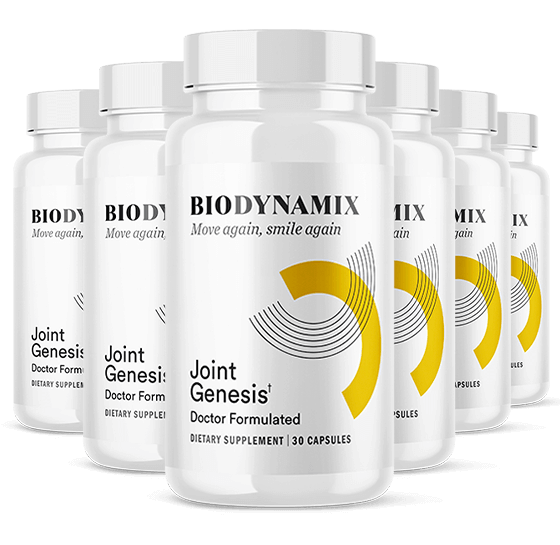
6 Bottles · 180-Day Supply
$49 / bottle
- ✓ You save $180 — biggest discount
- ✓ 180-day money-back guarantee
- ✓ 2 free bonus eBooks included
- ✓ Free shipping
Total: $474 $294 · free shipping

3 Bottles · 90-Day Supply
$69 / bottle
- ✓ You save $30
- ✓ 180-day money-back guarantee
- ✓ One-time payment, no subscription
Total: $237 $207 + shipping
Prices and bundle details shown are pulled directly from Joint Genesis’s official order page and can change — click any package above to see live current pricing.
For context on cost, here is what the official order page showed at the time we checked (prices can change): 2 bottles (60-day supply) at $79 per bottle, $158 plus shipping; 3 bottles (90-day supply) at $69 per bottle, $207 plus shipping; and 6 bottles (180-day supply) at $49 per bottle, $294 with free shipping and two bonus eBooks. Every tier is a one-time payment with no subscription, and a 180-day money-back guarantee applies. Cost matters to the efficacy question because a fair trial takes months, which we come back to below.
Does Joint Genesis work? The short version of what the evidence supports
Think of the evidence in two layers. The first layer is the ingredients. Hyaluronic acid is a natural component of the fluid that cushions and lubricates joints, and several small trials of oral hyaluronic acid in people with knee discomfort have reported modest improvements. Pine bark extract, ginger and boswellia each have small to moderate bodies of research suggesting a possible effect on pain and stiffness in osteoarthritis. None of that is nothing, and it is the reason a formula like this is not simply made up.
The second layer is the finished product, and here the picture is thinner. The main review found no independent, peer-reviewed trial of the Joint Genesis formula itself. That means any claim that this exact capsule, at its exact doses, improves comfort is an extrapolation from ingredient research. This is typical for the supplement category rather than unique to this brand, but it does mean you should hold the claims loosely.
Putting the layers together, here is a fair summary in plain terms:
- Plausible: some adults notice slightly less stiffness or easier movement after weeks of consistent use.
- Uncertain: how large the effect is, how long it lasts, and whether it comes from the supplement, from placebo response, from natural ups and downs in symptoms, or from other changes made at the same time.
- Unproven: that Joint Genesis rebuilds cartilage, reverses wear, or works better than other joint supplements. We found no independent evidence for those claims.
It is worth noting that the manufacturer avoids cure or disease-treatment language, according to our main review, which is more restrained than a lot of marketing in this category. Restrained marketing does not equal proven results, but it is a point in the product’s favor for honesty.
What can a joint supplement realistically do for stiffness and discomfort?
Joint aches after 50 usually have more than one cause. Cartilage thins with age, the joint lining can become irritated, muscles around the joint weaken from less activity, body weight adds load on knees and hips, and old injuries leave their mark. A capsule taken once a day addresses, at best, a small slice of that picture.
What a supplement may plausibly contribute
Ingredients like these are usually studied for modest changes in self-reported pain, stiffness and function, not for changes you can see on a scan. If a supplement helps, the typical description is something like “my knees feel a bit less creaky in the morning” or “stairs are slightly easier”, not “my joint pain is gone.” That framing is the most sensible way to judge Joint Genesis.
What a supplement cannot do
- It cannot replace a diagnosis. Joint pain can come from osteoarthritis, inflammatory arthritis, gout, tendon problems, nerve issues and more, and they are managed differently.
- It cannot substitute for prescribed medication or physical therapy.
- It cannot do the work of strength, balance and mobility training, which have far stronger evidence for knee and hip comfort than any capsule.
- It cannot be guaranteed to work for everyone. Individual responses vary widely, and many people in supplement trials, including those given a placebo, report feeling better.
If stiffness is your main complaint, our guide on what helps joint stiffness after 50 covers the non-supplement basics that tend to matter most.
What does the evidence say for Mobilee®, pine bark, ginger and boswellia?
Here is a high-level view, ingredient by ingredient. For a deeper breakdown, including the dose transparency question, see our dedicated Joint Genesis ingredients guide.
Mobilee® (hyaluronic acid complex, 80 mg disclosed)
Mobilee® is a patented, branded hyaluronic acid ingredient. Hyaluronic acid’s role in joint lubrication is well established as basic science. For the swallowed form, some small studies have reported modest benefit for knee discomfort, but many were funded by the ingredient’s supplier, and independent replication is limited. The widely repeated “10x hyaluronan” line is the manufacturer’s own characterization of the effect, as the main review stresses, and we have not seen it independently confirmed at the dose in this finished product. Our reading is moderate evidence for hyaluronic acid generally, and limited to moderate for the specific multiplier claim.
French maritime pine bark extract
Pine bark extract is rich in plant compounds with antioxidant activity. Small trials, mostly in knee osteoarthritis, have reported reductions in pain and stiffness, though the studies are modest in size and often use specific branded extracts at specific doses. The Joint Genesis label does not break out the pine bark dose, so we cannot say whether it matches what those trials used.
Ginger root
Ginger has a long traditional use for aches and a research record that includes trials and pooled analyses suggesting a small pain-relieving effect in osteoarthritis. The results vary a lot between studies, partly because preparations and doses differ. Again, the amount in this formula is not individually disclosed.
Boswellia serrata
Boswellia (Indian frankincense) extracts have been tested in knee osteoarthritis with some encouraging but uneven results. The type of extract and the dose appear to matter, which makes an undisclosed amount a genuine limitation for anyone trying to judge the formula.
BioPerine®
BioPerine® is a black pepper extract included to help absorption of other ingredients. It is not a joint ingredient itself. A word of caution: piperine can influence how the body handles some medications, so this is one more reason to mention the product to your pharmacist if you take prescription drugs.
Why does the lack of a finished-product trial matter?
When a company says “our formula works,” a careful reader should ask, “tested how, and by whom?” A study of Mobilee® alone does not tell you what happens when it is combined with four other ingredients at undisclosed amounts. Ingredient interactions, absorption and total dose can all change the result.
Here is what an ideal trial would look like and why its absence matters:
- The finished formula is tested, not just one component.
- A placebo group is included. Joint discomfort fluctuates and responds strongly to expectation, so without a comparison group it is hard to separate a real effect from hope.
- Participants and researchers are blinded so that neither group’s expectations color the reported results.
- Results are published and independently reviewed rather than summarized in a marketing page.
The absence of such a trial does not prove the product fails. It means that the question is open. The main review points out this gap is common across the supplement industry, and we agree. But “common” is not the same as “fine,” and it is the main reason we describe Joint Genesis as a reasonable thing to try with realistic expectations rather than a proven fix.
How long does Joint Genesis take to work, and what should you track?
The manufacturer’s own materials describe improvement building over roughly three months of consistent use, and the main review notes this is broadly consistent with how long this class of ingredients tends to need in research. That means two to three weeks is usually too short to judge, and a bottle or two is a partial trial at best.
A sensible way to run a fair trial
- Write down a baseline before you start. For one to two weeks, note morning stiffness (how many minutes until you loosen up), pain on a 0 to 10 scale at the same time each day, and two or three specific activities, such as climbing a flight of stairs or walking a set distance.
- Change one thing at a time. If you start a new supplement the same week as a new exercise program, you will not know which one helped. Ideally, start the supplement while keeping your other routines steady.
- Take it consistently, as directed on the label, and note any missed days.
- Check in at 30, 60 and 90 days. Re-rate the same measures. A change of one or two points on a 10-point scale, repeated across weeks, is more meaningful than a single good day.
- Decide in advance what counts as success. For example, “morning stiffness shortens by at least 10 minutes” or “I can do the stairs with less pain.” Having a pre-set bar keeps you from rationalizing.
- Review before the guarantee window closes. The refund window is 180 days per the manufacturer’s current terms, so set a calendar reminder well ahead of day 180.
Tracking sounds like a chore, but it is the single most useful thing you can do. Without it, almost any supplement can appear to “work” because symptoms naturally rise and fall.
Is the 180-day guarantee a fair way to test whether it works?
This is where Joint Genesis is stronger than much of the category. According to our main review, the manufacturer offers a 180-day money-back guarantee, which it says it honors even on empty bottles, and the purchase is one-time with no subscription or auto-ship. For a product whose effects are described as gradual, a long window is the right design: you can use it for the full three months, evaluate, and still have time to request a refund.
A few cautions are worth keeping in mind. First, the guarantee reduces financial risk but does not remove it, for example if you miss the window or do not follow the manufacturer’s process. Second, we have not verified a step-by-step refund procedure beyond what the manufacturer states, so confirm current terms on the official site before ordering and keep your order confirmation. Third, buying only from the official site matters, because refund terms apply to that purchase channel. Our guide on whether Joint Genesis is a scam, including pricing and refund details goes deeper on this.
Who is unlikely to benefit from Joint Genesis?
Being honest about who should probably skip this is part of an independent assessment. Joint Genesis is less likely to be a good fit if any of the following describes you.
- You want fast relief. If you are looking for something that works within days, this is not that kind of product, by the manufacturer’s own description.
- You have severe or rapidly worsening pain. A supplement is not an adequate response to significant pain, a joint that gives way, or a sudden loss of function. That needs medical evaluation.
- You are hoping to avoid or replace prescribed treatment. No supplement should replace medication or therapy recommended by your clinician.
- You need every ingredient individually dosed. Four of five ingredients are not given individual amounts, so if full transparency is non-negotiable, this will frustrate you.
- You take blood-thinning medication or several prescriptions and have not discussed it with a doctor or pharmacist first.
- You are not willing to commit to two to three months of consistent use and some basic tracking.
- You expect certainty. If you need clinical-trial proof of the exact product, it does not exist yet.
Beyond these groups, we would also expect a smaller chance of noticing anything if joint discomfort is mostly driven by factors a capsule cannot change, such as significant weakness around the knee, a mechanical problem in the joint, or a flare of an inflammatory condition.
Why do exercise, weight and a doctor’s evaluation matter more than any capsule?
If you remember one thing from this article, let it be this: the best-supported ways to ease everyday joint discomfort after 50 are not supplements.
Movement and strength
Regular, low-impact activity keeps joints nourished and muscles strong enough to share the load. Strengthening the muscles around the knee and hip is consistently linked with better comfort and function in people with osteoarthritis. Our guide to low-impact exercises for joint pain after 50 is a good free starting point, and our overview of joint and mobility wellness after 50 ties the pieces together.
Body weight
Extra body weight increases the load on weight-bearing joints, especially the knees. Even modest, sustained weight loss, where it is appropriate, is associated with less knee pain for many people. This is a conversation to have with your clinician rather than a quick fix.
A proper evaluation
A clinician can tell you whether your pain pattern fits osteoarthritis or something else, check for contributing issues, and suggest options ranging from physical therapy and footwear changes to medication or injections. A supplement experiment makes the most sense after that conversation, not instead of it.
Put another way: if you do all of the above and then add a supplement, you give yourself the best chance of both feeling better and being able to tell whether the supplement contributed.
When should joint pain be checked by a doctor right away?
Do not try to manage these with a supplement. Contact a healthcare professional promptly if you notice:
- Sudden joint pain or swelling that comes on without an obvious reason.
- A joint that is hot, red or visibly swollen, especially with fever or feeling unwell.
- Pain that follows a fall or injury, or a joint that cannot bear weight or feels unstable.
- Numbness, weakness or pain spreading into an arm or leg.
- Pain that wakes you at night, keeps worsening, or interferes with basic daily activities.
Also talk to a doctor or pharmacist before starting any new supplement if you take blood thinners or other prescription medication, have a diagnosed joint condition, or are managing another health problem. Some ingredients in joint formulas, such as ginger, pine bark and boswellia, are sometimes flagged in general safety guidance for people on anticoagulants, and our main review recommends checking with a doctor first if you take a blood thinner. If you have a shellfish allergy, the main review also advises checking the current label for allergen sourcing and contacting the manufacturer if anything is unclear. For knee pain specifically on stairs, see our piece on knee pain when walking down stairs for practical pointers and warning signs.
Frequently Asked Questions
Does Joint Genesis work for everyone?
No. Responses to joint supplements vary widely, and no supplement can guarantee a result for a specific person. Some people notice a gradual improvement; others notice nothing. That is consistent with how this whole product category performs in research.
What are realistic Joint Genesis results?
Realistic results are modest and gradual, such as slightly less morning stiffness or easier movement after weeks of consistent use. Dramatic, fast or permanent changes are not supported by the evidence we found. Keep a simple symptom log so you can judge for yourself.
How long should I take it before deciding?
Most descriptions of this ingredient class, including the manufacturer’s, point to around three months. Judging earlier than 60 days is probably unfair to the product. Because the guarantee runs 180 days per current terms, you can usually complete a full trial before deciding.
Has Joint Genesis been clinically tested?
The ingredients have been studied to varying degrees, and Mobilee® has research from its own supplier. We found no independent, peer-reviewed clinical trial of the finished Joint Genesis formula, so product-level results are unproven.
Is the “10x hyaluronan” claim proven?
It is the manufacturer’s characterization of what Mobilee® does, and we have not seen it independently confirmed for this finished product at its actual dose. Hyaluronic acid’s role in joint lubrication is established science, but that is not the same as proving the multiplier.
Can I take Joint Genesis with blood thinners or other medication?
Speak with your doctor or pharmacist first. Some of the botanical ingredients are commonly mentioned in general cautions for people on anticoagulants, and the black pepper extract can affect how certain drugs are processed. The manufacturer has not published detailed interaction data, so personalized advice from someone who knows your medication list is safer than any article.
What if it does not work for me?
Per the manufacturer’s current terms summarized in our main review, you can request a refund within 180 days of purchase. Confirm the current process on the official site, keep your order confirmation, and do not wait until the last week.
Should I try exercise first or a supplement first?
Exercise and strength work have stronger evidence, so they should be the foundation. If you want to add a supplement, doing so alongside a stable routine and tracking your symptoms lets you see whether it adds anything.
Our Take
Does Joint Genesis work? It might, modestly, for some people, and there is no independent proof that it will for you. The case in its favor is reasonable: a clearly dosed hyaluronic acid ingredient, three botanicals with some supporting research, a no-subscription purchase, and a long refund window that fits the slow timeline these ingredients seem to need. The case against is just as clear: no finished-product trial, four ingredients without individual doses, and a headline “10x” claim that is the manufacturer’s own.
Our balanced verdict is that Joint Genesis is a defensible option for an adult 50 or older who has already got the basics in place (movement, strength work, a doctor’s input), understands that results are uncertain, and is willing to track symptoms for about three months with the guarantee as a safety net. It is a poor choice for anyone seeking fast relief, a replacement for medical care, or full dosing transparency.
Related reading: if you want to dig deeper, see our Joint Genesis reviews and complaints breakdown for how to read what people say online, the ingredient-by-ingredient guide, and our roundup of the best-rated joint supplements for comparison. For the broader evidence on a more traditional approach, read does glucosamine and chondroitin work.
Disclosure: we may earn a commission if you buy through our links, at no extra cost to you, and this does not change our assessment.