Joint Genesis Ingredients Explained: Is the ’10x Hyaluronan’ Claim Hype or Help?
The Joint Genesis ingredients list is short: Mobilee®, French maritime pine bark extract, ginger root, Boswellia serrata and BioPerine®. Of those five, the research behind the featured one, a branded hyaluronic acid, is the most developed. The rest have supporting studies of varying size and quality. The part that deserves the most scrutiny is the headline “10x hyaluronan” claim, which is the manufacturer’s own characterization rather than something independently confirmed for the finished product.
In this guide we go through each ingredient in turn: what it is, what the evidence looks like, what is and is not disclosed about the dose, and what cautions apply. This Joint Genesis formula breakdown builds on the analysis in our full Joint Genesis review. As always, this is general information rather than medical advice, and the product is a dietary supplement, not a treatment for any diagnosed condition.

2 Bottles · 60-Day Supply
$79 / bottle
- ✓ 180-day money-back guarantee
- ✓ One-time payment, no subscription
Total: $158 + shipping
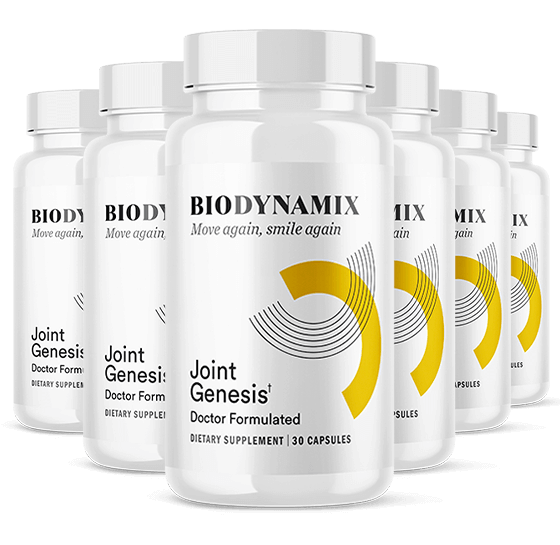
6 Bottles · 180-Day Supply
$49 / bottle
- ✓ You save $180 — biggest discount
- ✓ 180-day money-back guarantee
- ✓ 2 free bonus eBooks included
- ✓ Free shipping
Total: $474 $294 · free shipping

3 Bottles · 90-Day Supply
$69 / bottle
- ✓ You save $30
- ✓ 180-day money-back guarantee
- ✓ One-time payment, no subscription
Total: $237 $207 + shipping
Prices and bundle details shown are pulled directly from Joint Genesis’s official order page and can change — click any package above to see live current pricing.
For reference, the official order page showed these prices at the time we checked, and they can change: 2 bottles (60-day supply) at $79 per bottle, $158 plus shipping; 3 bottles (90-day supply) at $69 per bottle, $207 plus shipping; 6 bottles (180-day supply) at $49 per bottle, $294 with free shipping and two bonus eBooks. Purchase is one-time with no subscription, backed by a 180-day money-back guarantee.
Is the “10x hyaluronan” claim hype or help?
Let us start with the question in the title. The sales messaging says Mobilee® can multiply hyaluronan levels in the joints by a factor of ten, and frames that as restoring the lubricating quality of joint fluid. There are three separate ideas bundled into that sentence, and they deserve different levels of trust.
- Hyaluronic acid matters in joints. This is well-established biology. It is a major component of the fluid that lubricates and cushions joints.
- Swallowing a hyaluronic acid ingredient might influence joint comfort. This is plausible and has some small studies behind it, though the research is less settled and often supplier-funded.
- This specific product multiplies joint hyaluronan tenfold. This is the manufacturer’s characterization. Our main review found it rests mainly on the ingredient supplier’s own research, and it has not been independently verified for this finished product at its actual dose.
So our verdict is neither pure hype nor proven help. The first idea is solid, the second is reasonable, and the third should be read as marketing language until independent researchers confirm it. If that sounds like a lot of nuance, it is, and that is exactly why the claim deserves a closer look than a headline number allows.
What is actually in Joint Genesis?
The formula is a once-daily capsule from BIODYNAMIX®, which our main review describes as a fully identified company with a named medical research director. Here is a quick reference table before we go deeper.
| Ingredient | Disclosed dose | Role in the formula | Evidence level (our reading) |
|---|---|---|---|
| Mobilee® (hyaluronic acid complex) | 80 mg | Marketed to support joint fluid hyaluronan | Moderate for hyaluronic acid generally; limited to moderate for the 10x claim |
| French maritime pine bark extract | Not individually disclosed | Antioxidant; supports a normal inflammatory response | Small to moderate, mostly knee studies |
| Ginger root | Not individually disclosed | Traditional comfort support | Small to moderate, results vary |
| Boswellia serrata | Not individually disclosed | Supports a healthy inflammatory response | Small to moderate; depends on extract and dose |
| BioPerine® (black pepper extract) | Not individually disclosed | Absorption enhancer | Supports absorption of some compounds; not a joint ingredient itself |
The evidence labels above are our plain-language reading of the research landscape, informed by the main review. They are not a rating of the product’s performance and should not be read as a promise of results.
What is Mobilee®, and how strong is the evidence?
What it is
Mobilee® is a patented, branded hyaluronic acid ingredient sold by an ingredient supplier to supplement makers. Hyaluronic acid (also called hyaluronan) is a long sugar-based molecule found throughout the body, including in the fluid inside joints, in skin and in the eyes. In joints it contributes to the thick, slippery quality of synovial fluid. As we get older, the amount and quality of this fluid can change.
What the research suggests
Doctors sometimes inject hyaluronic acid directly into a knee, and that is a different thing from swallowing a capsule. The oral route is less intuitive, since digestion breaks large molecules down. Researchers have proposed that the fragments may still signal to the body in useful ways, and some small clinical studies of oral hyaluronic acid in adults with knee discomfort have reported modest improvements in comfort. But those studies tend to be small and short, and many involve the supplier. For Mobilee® specifically, our main review rates the evidence as limited to moderate, resting primarily on supplier research.
The dose
The label discloses 80 mg per serving. That is a real plus. Many competitors hide even the headline dose behind a “proprietary blend”, so this is a point in the product’s favor. We cannot tell you whether 80 mg is the ideal amount; what we can say is that you can at least compare it with the amounts used in published studies, which is not possible for the other four ingredients.
Practical cautions
Our main review notes that hyaluronic acid, in some research, may carry a mild interaction consideration for people on blood-thinning medication, so check with your doctor first if that applies. It also advises anyone with a shellfish allergy to review the current label for allergen sourcing, since some joint-supplement ingredients are shellfish-derived, and to contact the manufacturer if anything is unclear. We did not find the source material for Mobilee® stated in the main review, so we do not guess.
What does French maritime pine bark do in a joint formula?
French maritime pine bark extract comes from the bark of a pine tree grown in southwestern France. It contains plant compounds, mainly polyphenols called procyanidins, that act as antioxidants. In joint-related research, small randomized trials, largely in people with knee osteoarthritis, have reported less pain and stiffness and better function compared with placebo. That is encouraging, but the studies are modest in size and typically test a specific standardized extract at a specific daily amount.
That last point is the key limitation here. The Joint Genesis panel says “pine bark extract” without a milligram figure and without naming a standardized brand, so a reader cannot match it to the amounts used in trials. A little in the capsule might do very little; a standardized amount might do something. The label does not let you tell the difference.
Cautions: pine bark extract is often mentioned in general guidance for people who take anticoagulant or antiplatelet medicines, because plant polyphenols may affect clotting in some people. People taking medication for blood pressure or diabetes, or who are due for surgery, should also ask their clinician. These are general, widely repeated cautions, not statements about this particular product.
How well does ginger hold up as a joint ingredient?
Ginger root has been used for centuries for aches and stomach upset, and it contains pungent compounds such as gingerols and shogaols that have anti-inflammatory activity in the laboratory. Clinical trials of ginger extracts in osteoarthritis, along with pooled analyses of them, tend to find a small average reduction in pain, but with a lot of variation between studies. Differences in preparation (powder, extract, standardized or not) and in dose probably explain part of that.
In practical terms: ginger is a reasonable inclusion, with modest and inconsistent support, and its contribution to Joint Genesis cannot be gauged without knowing the amount. A capsule can hold far less ginger than the amounts studied, which are often around a gram or more of ginger material in various forms. We are not suggesting this product falls short, only that the label leaves the question unanswerable.
Cautions: ginger can cause heartburn or mild stomach upset for some people. Large amounts are also sometimes flagged for people on blood thinners. Check with your doctor if you take anticoagulants or have a bleeding disorder.
What is the evidence for Boswellia serrata?
Boswellia serrata, sometimes called Indian frankincense, yields a resin whose active compounds, boswellic acids, have been studied for effects on inflammatory pathways. Randomized trials in knee osteoarthritis have reported improvements in pain and function with certain extracts, and some include extracts enriched in a boswellic acid called AKBA. Quality is uneven, and the results seem to depend heavily on which extract is used and how much.
That dependence is what makes the undisclosed dose a genuine issue for boswellia specifically. Two products that both list “boswellia” can contain very different amounts of the compounds that matter. Without a standardization percentage or a milligram figure, there is no way to compare Joint Genesis with the studied extracts.
Cautions: boswellia is generally well tolerated in studies, with mild stomach upset the most commonly reported issue. As with the others, discuss it with a clinician if you take blood thinners, anti-inflammatory medicines, or have an inflammatory bowel or autoimmune condition.
What does BioPerine® add?
BioPerine® is a branded black pepper extract standardized for piperine. It is not there to help your joints directly. It is included because piperine has been shown to increase the absorption of certain compounds, including some plant extracts, by influencing how they are processed in the gut and liver. The idea is to help the other ingredients go further.
It is a common, generally low-dose addition, as our main review puts it. The same property that makes it useful is also a reason for a pharmacist check: because piperine can alter how the body handles some medicines, people on prescription drugs with narrow safety margins should ask before adding any supplement containing it. The label also does not disclose how much is used, though low amounts are typical.
Why does the dose transparency gap matter?
Four of the five ingredients in Joint Genesis are listed without individual amounts. The main review calls this a real limitation but not a disqualifying one, and we agree with both halves of that sentence.
Why it is a real limitation
- You cannot compare to research. Trials use particular amounts. Without a number, you cannot tell whether the capsule resembles the tested dose or is a token amount included so the ingredient can appear on the front of the bottle.
- You cannot compare products. If another formula lists 500 mg of an extract and this one lists none, you cannot judge the better value.
- You cannot judge safety margins. Knowing the amount matters when you are weighing a medication interaction.
Why it is not disqualifying
- The headline ingredient dose is disclosed, which is better than a lot of the category.
- The manufacturer identity, address and medical director are public, so there is someone accountable.
- A 180-day refund window gives a safety net while you find out whether the formula suits you.
If dose transparency matters a great deal to you, a practical step is to ask the manufacturer for the amounts and the standardization of each extract before you buy, and treat a clear answer as a good sign. We do not know what response you would receive, so we do not claim one.
How does the Joint Genesis formula compare with glucosamine, chondroitin, collagen and turmeric products?
Shoppers rarely consider Joint Genesis in isolation. Here is a general comparison of the main approaches, without naming specific competitors.
Glucosamine and chondroitin
This is the most heavily studied combination in the joint supplement world, and the results are mixed: some trials have found modest benefit for some people, and others have found little difference from placebo. A big advantage is that doses are typically listed clearly, so you know what you are buying. Glucosamine is commonly made from shellfish shells, which matters for allergy sufferers, and glucosamine has been reported to interact with warfarin in some people, so a conversation with a clinician is wise. For more on the evidence, read our guide on whether glucosamine and chondroitin work. Our main review notes that a well-studied, individually dosed glucosamine or chondroitin product may be a more budget-friendly starting point.
Collagen products
Collagen supplements, usually hydrolyzed collagen peptides, are studied for cartilage and joint comfort, with small trials suggesting possible benefits and plenty of uncertainty. They work through a different mechanism from hyaluronic acid. Our overview on collagen for joints explains what research does and does not show.
Turmeric and curcumin formulas
Turmeric, or its active compound curcumin, is another popular joint ingredient. Curcumin is poorly absorbed on its own, so many products pair it with black pepper extract or use special delivery forms, much as Joint Genesis uses BioPerine® for its own ingredients. Trials in knee osteoarthritis have reported modest comfort improvements, with the usual caveats about study quality. Interestingly, Joint Genesis does not contain turmeric, so it takes a different route to the same “inflammatory response” territory using pine bark, ginger and boswellia.
How to think about the choice
| Approach | Typical strength | Typical weakness |
|---|---|---|
| Hyaluronic acid plus botanicals (like this formula) | Combines a lubrication-themed ingredient with plant extracts | Many plant doses undisclosed; product-level trials rare |
| Glucosamine and chondroitin | Long research history; clear doses | Mixed results; shellfish sourcing common |
| Collagen peptides | Simple, usually well tolerated | Evidence still developing |
| Turmeric or curcumin | Widely studied plant compound | Absorption issues; modest effects |
None of these is clearly superior for everyone. If you are still weighing your options, our best-rated joint supplement roundup can help you compare.
Who should check with a professional before taking these ingredients?
The checklist is the same one we would apply to any joint supplement, not a sign this product is unusually risky.
- Anyone on blood thinners (for example anticoagulants or antiplatelet drugs), because several ingredients here are mentioned in general interaction cautions.
- Anyone with a shellfish allergy, who should read the label carefully and contact the manufacturer about sourcing if it is not clear.
- Anyone with a diagnosed joint condition, such as rheumatoid arthritis or advanced osteoarthritis, who should involve their treating physician.
- People taking several prescriptions, given the black pepper extract’s effect on how some drugs are processed.
- People who are pregnant or breastfeeding, since safety has not been established.
- Anyone with an upcoming surgery, since some botanicals are commonly paused ahead of procedures on medical advice.
Mild digestive upset is the side effect most often mentioned for this ingredient category. If you notice anything more significant, stop and speak with a clinician. And if your joint pain is sudden, comes with fever, redness or heat, or follows an injury, see a doctor rather than trying a supplement.
Frequently Asked Questions
What are the ingredients in Joint Genesis?
Mobilee® (a hyaluronic acid complex, 80 mg disclosed), French maritime pine bark extract, ginger root, Boswellia serrata and BioPerine® (black pepper extract). Always check the current label on the official site, because formulas can be updated.
Is the “10x hyaluronan” claim true?
It is the manufacturer’s own characterization of Mobilee®, resting mainly on the ingredient supplier’s research. We have not seen independent confirmation that the finished product raises joint hyaluronan tenfold at its actual dose, so treat it as a marketing claim rather than an established fact.
Does oral hyaluronic acid really reach the joints?
That is an open scientific question. Digestion breaks down large molecules, and researchers are still studying how swallowed hyaluronic acid may influence joints. Some small studies report modest comfort improvements, but the mechanism is not settled.
Why are only some Joint Genesis ingredients dosed?
Only the featured ingredient has a disclosed amount. The manufacturer has not explained the reasons publicly, to our knowledge. The practical effect is that you cannot confirm the other four are present at amounts used in research.
Does Joint Genesis contain glucosamine, chondroitin or turmeric?
No. It does not list glucosamine, chondroitin, collagen or turmeric. Its approach uses a hyaluronic acid ingredient together with pine bark, ginger and boswellia.
Is BioPerine® safe?
Black pepper extract is widely used and generally well tolerated at typical supplement amounts, but it can change how the body handles certain medicines. Ask your pharmacist if you take prescription drugs.
Is Joint Genesis safe with blood thinners?
Speak to your doctor first. Several of the ingredients are commonly named in general cautions for people on anticoagulants, and our main review also recommends checking beforehand.
Is a single-ingredient supplement a better choice?
Not necessarily. A simpler, well-studied and clearly dosed product can be easier to evaluate and cheaper, while a multi-ingredient formula offers convenience. The best choice depends on your goals, budget and health situation.
Our Take
On the ingredient question, Joint Genesis is a conventional formula with one clear strength and one clear weakness. The strength is a transparently dosed hyaluronic acid ingredient, backed by real if modest and supplier-heavy research. The weakness is that the four supporting ingredients appear without individual doses, which makes it impossible for a reader to check them against the studies that give them credibility. The “10x hyaluronan” line is best understood as the manufacturer’s framing; it is not proof.
That makes the formula a reasonable option to consider, with realistic expectations, for an adult 50 or older who values the hyaluronic acid approach, has checked with a doctor or pharmacist where relevant, and is comfortable that the guarantee is the real safety net. It is less appealing for someone who needs every milligram disclosed or wants product-level clinical proof.
Related reading: for the efficacy angle see does Joint Genesis really work; for what people say online see Joint Genesis reviews and complaints; and for practical lifestyle steps see joint and mobility wellness after 50.
Disclosure: we may earn a commission if you buy through our links, at no extra cost to you, and this does not change our assessment.