What’s in TitanFlow? Ingredients
TitanFlow’s biggest differentiator isn’t a secret ingredient — it’s that there’s no secret at all. Every one of its five ingredients, and the exact milligram dose of each, is printed openly on the supplement facts panel. That’s rarer than it should be in this category, where “proprietary blend” labeling is a common way for companies to obscure how little of an active ingredient is actually in each capsule. This piece goes through TitanFlow’s formula ingredient by ingredient — what each one is, what the research actually says about it, and how TitanFlow’s specific dose compares to the amounts used in that research, plus the manufacturing and absorption details that affect whether those ingredients can realistically do what the label suggests. For pricing, the company’s business record, and our overall verdict, see our complete TitanFlow review.
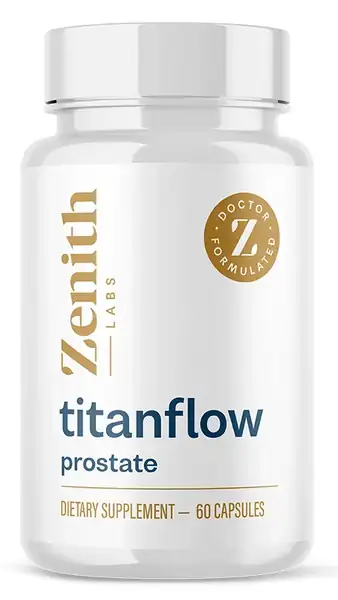
1 Bottle · 30-Day Supply
$59 / bottle
- ✓ Try it before committing to a bundle
- ✓ 180-day money-back guarantee
- ✓ $9.95 shipping, one-time payment
Total: $68.95 shipped
3 Bottles · 90-Day Supply
$49 / bottle
- ✓ Enough for a full 90-day evaluation window
- ✓ 180-day money-back guarantee
- ✓ Free U.S. shipping, one-time payment
Total: $147 shipped
6 Bottles · 180-Day Supply
$39 / bottle
- ✓ Save $120 vs. buying 6 singly
- ✓ 180-day money-back guarantee
- ✓ Free U.S. shipping, one-time payment
Total: $234 shipped
Prices and package details shown are pulled from currently available marketing sources and can change — click any package above to see live current pricing on the official order page.
The Full Formula at a Glance
Each two-capsule daily serving of TitanFlow contains five plant-derived ingredients: pumpkin seed oil (500 mg), pygeum africanum extract at a 4:1 concentration (100 mg), a beta-sitosterol complex (30 mg), lycopene at 5% concentration (37.5 mg), and broccoli extract at a 4:1 concentration (50 mg). Each bottle holds 60 vegetable capsules — a 30-day supply at the labeled dose of two capsules daily, typically taken with a meal to reduce the chance of digestive discomfort.
Pumpkin Seed Oil (500 mg) — The Largest Ingredient by Weight
Pumpkin seed oil is extracted from the seeds of Cucurbita pepo and is one of the more extensively studied natural compounds for lower urinary tract symptoms associated with an enlarged prostate. It’s rich in phytosterols, zinc, and essential fatty acids, all of which have plausible mechanistic connections to prostate and urinary health. A 2019 study published in the Journal of Medicinal Food found meaningful improvements in urinary symptom scores at a daily dose of 1,000 mg. TitanFlow’s 500 mg dose is half that amount. It’s reasonable to expect some benefit even at a reduced dose, since dose-response curves for plant compounds aren’t always linear, but this is the clearest example in the formula of an evidence-backed ingredient included at less than the amount its own supporting research actually used.
One practical note: pumpkin seed oil supplements are commonly associated with a mild, lingering aftertaste some users describe as unpleasant — a known characteristic of the ingredient generally, not a defect specific to TitanFlow’s formulation.
Pygeum Africanum Extract, 4:1 (100 mg) — The Best-Dosed Ingredient in the Formula
Pygeum africanum is derived from the bark of the African cherry tree and has one of the strongest evidence bases of any natural compound used for prostate and urinary symptom support. A Cochrane systematic review — widely regarded as the gold standard for aggregating and evaluating clinical evidence, because it combines results across multiple randomized controlled trials rather than relying on any single study — found that pygeum extract improved overall urological symptom scores and peak urine flow rates compared to placebo, across studies using daily doses between 75 and 200 mg.
TitanFlow’s 100 mg dose sits comfortably within that studied range, making pygeum the one ingredient in this formula dosed at a level genuinely consistent with the research supporting it — worth calling out explicitly, since it’s easy for a “some ingredients underdosed” narrative to obscure the fact that this isn’t true across the board. If you’re specifically interested in the ingredient with the strongest research-to-dose match in this formula, it’s this one.
Beta-Sitosterol Complex (30 mg) — Underdosed Relative to Clinical Trials
Beta-sitosterol is a plant sterol structurally similar to cholesterol, and it’s shown benefits for urinary flow rate and post-void residual bladder volume (a measure of incomplete emptying) across multiple randomized controlled trials. Most of those trials used daily doses around 60 mg. TitanFlow’s 30 mg dose is half that amount — the second ingredient in the formula, alongside pumpkin seed oil, dosed below its own cited research.
It’s worth noting that beta-sitosterol is also the ingredient in this formula most relevant to a specific safety consideration: it’s structurally similar enough to cholesterol that it can interact with statin medications (commonly prescribed to manage cholesterol), so anyone taking a statin should talk to a doctor or pharmacist before adding a beta-sitosterol-containing supplement like TitanFlow to their routine.
Lycopene, 5% (37.5 mg) — Evidence-Based but Harder to Dose-Match
Lycopene is the carotenoid pigment responsible for the red color in tomatoes, watermelon, and similar produce, and it has a genuine antioxidant profile with observational research linking higher dietary lycopene intake to better long-term prostate health outcomes. The caveat here is that most of the strongest lycopene research is observational — tracking people’s diets and outcomes over time — rather than from controlled trials testing a specific supplemental dose, which makes it inherently harder to say whether TitanFlow’s 37.5 mg dose is “enough” the way we can more precisely evaluate pygeum or beta-sitosterol against trial data. What can be said is that 37.5 mg sits toward the lower-to-moderate end of amounts typically used in lycopene supplementation research generally.
Broccoli Extract, 4:1 (50 mg) — Supportive but Without a Prostate-Specific Benchmark
Broccoli extract is included primarily for its sulforaphane content, a sulfur-containing compound with well-documented general antioxidant and cellular-health research behind it. Unlike the other four ingredients in this formula, there isn’t a standardized, prostate-specific dosage benchmark established in the research literature to compare TitanFlow’s 50 mg dose against — which makes this the hardest ingredient in the formula to evaluate on a “does the dose match the evidence” basis, simply because that specific evidence doesn’t clearly exist yet in the way it does for pygeum or beta-sitosterol. It’s a reasonable, low-risk inclusion, but its role here is best understood as general supportive antioxidant content rather than a targeted, well-quantified urinary-health ingredient.
Why Two Underdosed Ingredients Doesn’t Automatically Mean the Formula Fails
It’s tempting to average across all five ingredients and conclude the formula is “half-strength,” but that’s an oversimplification worth correcting. Pygeum — arguably the ingredient with the strongest, most directly comparable clinical evidence in the entire formula — is dosed correctly. Lycopene and broccoli extract don’t have a clean dose-to-evidence benchmark to fall short of in the first place. That leaves genuinely two ingredients, pumpkin seed oil and beta-sitosterol, dosed at roughly half their cited research amounts. That’s a legitimate point of criticism, and one worth weighing seriously, but it’s meaningfully different from “the whole formula is underdosed,” which overstates the actual gap.
What TitanFlow Deliberately Left Out
It’s worth noting what’s not in this formula, because the omission appears deliberate rather than accidental. Saw palmetto is the single most commonly used ingredient across competing prostate supplements, to the point that many buyers assume any legitimate product in this category must contain it. Several major randomized controlled trials — including a well-known, NIH-funded study published in 2011 — found saw palmetto performed no better than placebo at commonly used doses for BPH symptoms. TitanFlow’s formulators appear to have made an evidence-aware choice to leave it out in favor of pygeum and beta-sitosterol, both of which have somewhat more consistent trial support. Whatever you conclude about TitanFlow’s dosing decisions elsewhere, choosing not to include a heavily-marketed but weakly-supported ingredient is a reasonable, defensible formulation call.
Ingredient Safety and Interaction Considerations
None of TitanFlow’s five ingredients carry major safety red flags at the doses used, and the most commonly reported side effects are mild and digestive — occasional nausea, bloating, or the pumpkin-seed-oil aftertaste mentioned earlier. The two interaction points worth flagging directly: beta-sitosterol’s structural similarity to cholesterol means it can interact with statin medications, and the formula’s combined anti-inflammatory plant compounds could theoretically interact with blood-thinning medications, though this is a general caution common to many plant-based anti-inflammatory supplements rather than a documented TitanFlow-specific interaction. If you take a statin, a blood thinner, or any prescription medication, check with your doctor or pharmacist before starting TitanFlow — a two-minute conversation that removes essentially all of the realistic risk here.
How This Formula Compares to a Typical Competitor’s Ingredient Panel
Most competing prostate supplements fall into one of two categories: those built around a “proprietary blend” that discloses total blend weight but not individual ingredient doses (making this exact kind of dose-versus-evidence analysis impossible for the buyer to do at all), and those built primarily around saw palmetto, the most heavily marketed but least consistently supported ingredient in this space. TitanFlow’s full-disclosure label and its choice to build around pygeum and beta-sitosterol instead of saw palmetto both represent above-average formulation transparency and evidence-awareness for this category — even accounting for the two ingredients dosed below their own cited research.
How Manufacturing Quality Affects Whether These Ingredients Actually Deliver
An ingredient list is only half the story — how a supplement is manufactured affects whether the labeled amounts are what’s actually in the capsule, and whether the plant extracts retain their active compounds through processing. TitanFlow is manufactured in an FDA-registered, GMP-certified (Good Manufacturing Practice) facility in the United States, according to the company. GMP certification means the facility follows standardized protocols for quality control, ingredient testing, and contamination prevention — it doesn’t independently verify that a specific batch matches its label exactly, but it’s a meaningfully higher manufacturing standard than facilities without that certification, and it’s the same baseline standard most reputable supplement brands operate under.
The extraction ratios listed for pygeum (4:1) and broccoli extract (4:1) indicate concentrated extracts — meaning four parts of the raw plant material were processed down to one part of the finished extract, concentrating the active compounds rather than using raw, unprocessed plant powder. This is a more rigorous and generally more potent form of these ingredients than simply grinding the raw plant, though it’s worth noting that a stated extraction ratio alone doesn’t guarantee a specific concentration of the actual active compounds (like the specific sterol content in pygeum) without third-party lab verification, which isn’t publicly published for TitanFlow’s specific batches.
TitanFlow’s capsules are vegetable-based rather than gelatin, which matters specifically for vegetarian, vegan, or religious dietary considerations — a small but relevant detail for anyone avoiding animal-derived gelatin capsules, and one that’s easy to overlook when comparing formulas that otherwise look similar on paper.
Absorption and Timing Considerations
Several of TitanFlow’s ingredients — particularly pumpkin seed oil and beta-sitosterol — are fat-soluble compounds, meaning they’re absorbed more efficiently when taken alongside dietary fat. The label’s instruction to take the capsules with a meal isn’t just about reducing digestive discomfort; it likely also improves absorption of these specific compounds compared to taking them on an empty stomach. If you’re trying to give the formula a fair evaluation, taking both daily capsules together with your largest or highest-fat meal of the day, rather than split apart or on an empty stomach, is a reasonable way to maximize whatever absorption advantage the formula’s fat-soluble ingredients can offer.
Consistency matters more than timing precision, though. Since the underlying research suggests a 60–90 day window before effects would reasonably be expected, missing an occasional dose is far less consequential than taking the supplement sporadically over that period — the ingredients here are not fast-acting compounds where a missed day meaningfully resets progress, but consistent daily intake over the full evaluation window is what the supporting research is actually based on, and it’s the same standard any of the underlying clinical trials used with their own participants.
Frequently Asked Questions
Which TitanFlow ingredient has the strongest research backing?
Pygeum africanum, both in terms of the quality of evidence (a Cochrane systematic review) and because TitanFlow’s 100 mg dose falls within the studied effective range.
Which ingredients are underdosed compared to their cited research?
Pumpkin seed oil (500 mg vs. 1,000 mg studied) and beta-sitosterol (30 mg vs. ~60 mg studied) are both included at roughly half the amount used in the research TitanFlow’s own marketing points to.
Why isn’t saw palmetto in this formula?
Multiple large randomized trials, including a major NIH-funded study, found saw palmetto performs no better than placebo for BPH symptoms at typical doses — TitanFlow’s formulators appear to have chosen pygeum and beta-sitosterol instead for that reason.
Are there any drug interactions to know about?
Beta-sitosterol can interact with statin (cholesterol-lowering) medications, and the formula’s anti-inflammatory compounds could theoretically interact with blood thinners. Check with a doctor or pharmacist if you take either.
Is a fully disclosed label actually better than a proprietary blend?
Generally, yes — full disclosure lets you independently verify doses against research, the way this article does. A proprietary blend prevents that kind of analysis entirely, which is itself a meaningful transparency disadvantage regardless of what’s actually inside it.
Should I take TitanFlow with food?
Yes — several of its ingredients, including pumpkin seed oil and beta-sitosterol, are fat-soluble and likely absorb better alongside a meal containing some dietary fat, and taking it with food also tends to reduce mild digestive side effects.
Does the vegetable capsule matter if I’m not vegetarian?
Not functionally — the capsule material doesn’t meaningfully affect the ingredients inside or their overall effectiveness. It’s relevant specifically if you avoid gelatin for dietary, religious, or personal reasons.
Does GMP certification guarantee the label is accurate?
It significantly raises the likelihood, since GMP facilities follow standardized quality-control and testing protocols, but it isn’t the same as an independent, batch-specific third-party lab test verifying exact potency, which isn’t publicly published for TitanFlow as of this writing.
A Note on Interpreting “Clinically Studied” Ingredient Claims
One phrase worth understanding whenever you see it on a supplement label — TitanFlow’s or any competitor’s — is “clinically studied ingredients.” This claim is technically accurate here: pumpkin seed oil, pygeum, beta-sitosterol, and lycopene have all genuinely appeared in published clinical or observational research. But the phrase describes the ingredients, not the finished product, and it’s easy to read it as implying the whole formula has been clinically validated when that’s a separate and unverified claim. This isn’t unique to TitanFlow — it’s standard practice across the supplement industry — but understanding the distinction is the single most useful piece of label literacy for evaluating any product in this category, prostate supplements included.
Our Take
TitanFlow’s ingredient panel earns real credit for transparency and for a genuinely evidence-aware formulation choice (pygeum and beta-sitosterol over the more heavily marketed but weakly supported saw palmetto), and one ingredient — pygeum — is dosed exactly in line with the research behind it. Two others fall short of their cited studies by roughly half, which is a fair and specific criticism rather than a reason to dismiss the formula outright. If you want to see how this ingredient analysis translates into an overall effectiveness verdict, read our deep dive into whether TitanFlow actually works, or see what real customers report in our review of public TitanFlow feedback.