ProvaDent Ingredients List
ProvaDent Ingredients List: A Full Breakdown of What’s Inside
Searching for the full ProvaDent ingredients list before you order? If you’re the type of buyer who wants to know exactly what you’re putting in your mouth, this article is for you. We went through every ingredient listed on the official ProvaDent order page, checked what independent research actually exists for each one, and flagged anywhere the manufacturer doesn’t disclose enough detail to fully evaluate the claim. This is the companion piece to our full ProvaDent review, focused specifically and exclusively on the ProvaDent ingredients list.
For reference, here are ProvaDent’s current package options — for the full ingredient breakdown, guarantee terms, and complete analysis, see our full ProvaDent review.

1 Bottle · 30-Day Supply
$69 / bottle
- ✓ 30-day supply to try the formula
- ✓ 60-day money-back guarantee
- ✓ Secure one-time payment
Total: $69 + shipping
3 Bottles · 90-Day Supply
$59 / bottle
- ✓ 2 free bonus guides included ($147 value)
- ✓ 60-day money-back guarantee
- ✓ Free US shipping
Total: $177 + free shipping
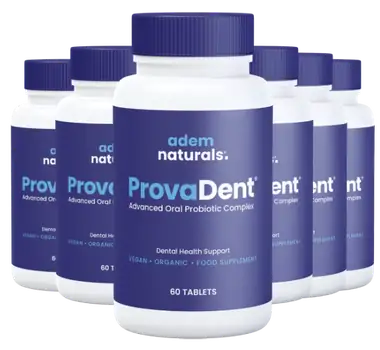
6 Bottles · 180-Day Supply
$49 / bottle
- ✓ Lowest price per bottle + 2 free bonuses
- ✓ 60-day money-back guarantee
- ✓ Free US shipping
Total: $294 + free shipping
Prices and package details shown are pulled from currently available marketing sources and can change — click any package above to see live current pricing on the official order page.
The Full ProvaDent Ingredients List
ProvaDent’s label, as described on the official order page, lists five components: Organic Xylitol, BioFresh™ Clean Complex, Cranberry Extract, Purple Carrot Powder, and four unnamed strains of probiotics. It’s delivered as a chewable tablet, with 60 tablets per bottle framed as a 30-day supply — meaning a standard daily serving works out to two tablets. Below, we go through each one individually.
Organic Xylitol
Xylitol is a naturally occurring sugar alcohol, commonly derived from birch or corn, that has one of the more solid independent research records of any ingredient in this formula. The key mechanism: certain bacteria strongly associated with tooth decay and plaque, most notably Streptococcus mutans, cannot efficiently metabolize xylitol the way they metabolize regular sugars. Over time and with regular exposure, this is understood to help shift the oral bacterial population away from these decay-associated strains.
This isn’t a novel or unproven mechanism specific to ProvaDent — it’s the same reasoning behind xylitol’s inclusion in a wide range of established oral-care products, including sugar-free gums and certain toothpaste formulations marketed for cavity prevention. Most published xylitol research uses gum or lozenge formats with multiple exposures per day, so it’s worth noting that a twice-daily chewable tablet is a related but not identical delivery method to what much of that research actually tested. Still, of every ingredient in the ProvaDent formula, this is the one with the clearest, most independently verifiable evidence trail behind it.
BioFresh™ Clean Complex
This is where ProvaDent’s transparency is weakest. The order page describes this only as “our proprietary blend of natural ingredients that contribute to a clean, vibrant oral environment,” without listing what’s actually in it or at what dosage. Proprietary blends are legal and common across the supplement industry, but they carry a real tradeoff for the buyer: you cannot look up the individual ingredients against their own research, check dosage levels against studied amounts, or screen for a specific allergen or sensitivity the way you could with a fully disclosed ingredient panel.
We have no basis to claim this blend is ineffective or unsafe — we simply have no way to verify what it contains, which means any specific benefit attributed to “BioFresh Clean Complex” as a named entity can’t be checked against outside research the way xylitol’s benefits can. If ingredient-level transparency matters to you, this is the single component in ProvaDent’s formula that falls furthest short of that standard.
Cranberry Extract
Cranberry is best known for research around urinary tract health, largely attributed to compounds called proanthocyanidins that appear to interfere with certain bacteria’s ability to adhere to surfaces in the body. A smaller, more specific body of research has looked at whether similar anti-adhesion properties apply to oral bacteria and plaque formation, with some studies suggesting a modest reduction in bacterial adhesion to tooth surfaces when cranberry compounds are present.
The caveat here is concentration and standardization: cranberry extract products vary widely in how concentrated their active proanthocyanidin content is, and ProvaDent’s order page doesn’t specify the extract’s standardization or dosage. That means we can confirm cranberry extract is a reasonable, research-supported ingredient category to include in an oral-health formula, without being able to confirm ProvaDent’s specific dose matches what’s been used in the relevant studies.
Purple Carrot Powder
Purple carrots are a genuine source of anthocyanins — the same broad class of antioxidant pigment compounds found in blueberries and other purple or deep-red produce — along with general nutritional value including fiber and vitamin A precursors. On the ProvaDent order page, this ingredient is described in notably more general terms than the others: “packed with nutrients, purple carrot powder contributes to your overall well-being,” without a specific oral-health mechanism attached the way xylitol and cranberry extract each get.
That vaguer framing is itself informative. It suggests purple carrot powder is functioning more as a general nutritional and antioxidant addition to round out the formula than as a targeted active ingredient for gum or tooth health specifically. It’s not a concerning inclusion by any means, but if you’re evaluating ProvaDent specifically for its oral-health mechanisms, this ingredient is doing comparatively little of that particular work.
4 Strains of Probiotics (Undisclosed)
This is the ingredient category most central to ProvaDent’s core pitch, and also the least transparent. The order page states the product contains “4 strains of probiotics” that “work together to support oral wellness” and “help you maintain a balanced mouth microbiome,” but does not name the specific bacterial strains, their genus and species, or the colony-forming-unit (CFU) count per serving.
This matters more for probiotics than it would for most other supplement ingredients, because probiotic research is highly strain-specific. Two products can both say “probiotics” while containing completely different organisms with entirely different (or nonexistent) research behind them for a given use case. In the oral-probiotic space specifically, some competing products disclose well-studied strains such as Streptococcus salivarius (including the branded BLIS K12 and M18 strains) or specific Lactobacillus reuteri strains, each with published research on outcomes like reduced gingival bleeding or lower volatile sulfur compound levels associated with bad breath. Because ProvaDent doesn’t name its strains, there’s no way to check whether its blend overlaps with those better-studied options or uses a different, less-researched selection — and no way to verify the CFU count is high enough to be biologically meaningful, since probiotic effectiveness is generally understood to be dose-dependent.
Understanding the Oral Microbiome: Why These Ingredient Categories Exist
To evaluate ProvaDent’s ingredient choices fairly, it helps to understand the underlying science they’re built around. Your mouth hosts an estimated several hundred distinct bacterial species at any given time, forming what researchers call the oral microbiome — a community that, similar to the gut microbiome, exists in a rough balance between beneficial and potentially harmful species. Problems like plaque buildup, gum inflammation, cavities, and bad breath are increasingly understood not just as a hygiene failure, but as signs that this balance has shifted toward bacteria associated with those outcomes, often accelerated by sugar intake, certain medications, dry mouth, or inconsistent oral hygiene.
This is the scientific premise ProvaDent (and the broader oral-probiotic category) is built on: that you can support a healthier balance by introducing more beneficial bacterial strains (the probiotic component) while also making the environment less hospitable to the harmful ones (xylitol’s role) and providing supporting antioxidant and nutritional compounds (cranberry extract, purple carrot powder). It’s a scientifically reasonable framework in principle — dental researchers do study oral microbiome balance as a legitimate factor in gum and tooth health — but as covered above, how well any specific product executes on that framework depends entirely on ingredient quality, dosage, and strain selection, which is exactly where ProvaDent’s disclosure falls short in a couple of places.
Serving Size, Format, and How to Take It
ProvaDent is formulated as a chewable tablet rather than a swallowed capsule, which is a meaningful, deliberate format choice for an oral-health product. Because the tablet is chewed rather than swallowed whole, the active ingredients have direct contact with the teeth, gums, and oral bacteria during the chewing process itself, rather than only being absorbed after digestion. This delivery method lines up with how xylitol research is typically conducted — via gum, lozenges, or chewable formats that maximize direct oral-cavity contact time — more closely than a standard swallowed capsule would.
Each bottle contains 60 tablets, and the label frames this as a 30-day supply, which works out to a standard serving of two tablets per day. The order page doesn’t specify an exact recommended time of day (such as after meals or before bed), so if timing optimization matters to you, following general xylitol-product guidance — spacing doses after meals when bacterial acid production is highest — is a reasonable, evidence-informed approach even though ProvaDent’s own label doesn’t spell this out explicitly.
How ProvaDent’s Formula Compares to ProDentim’s
Since ProDentim is the category’s best-known product and a natural point of comparison, it’s worth noting a few formula-level differences. ProDentim’s publicly disclosed formula centers on a different probiotic strain lineup along with ingredients like inulin, malic acid, and peppermint, and — as covered in our ProDentim review — it also doesn’t fully disclose every ingredient’s exact dosage. ProvaDent’s formula, by contrast, leans more heavily on xylitol and cranberry extract as its disclosed actives, with a comparatively simpler five-component label. Neither formula is objectively “better” in a way that’s independently provable without disclosed strain and dosage data from both companies — the honest takeaway is that both products share the same core transparency limitation around their probiotic components specifically, even though the rest of their formulas differ.
What’s Notably Absent From the Label
It’s also worth noting what ProvaDent’s ingredient list doesn’t include, for context. There’s no fluoride, no calcium or phosphate remineralizing compounds, and no CoQ10 (an ingredient some competing oral-health supplements include for gum tissue support). This isn’t necessarily a weakness — a product doesn’t need every possible oral-health ingredient to have a coherent formula — but it does mean ProvaDent’s approach is narrower and more probiotic-and-xylitol-focused than some broader-spectrum competitors, which is useful context if you’re comparing multiple products’ ingredient panels side by side.
What's good
- Xylitol and cranberry extract both have real, independently published research behind their oral-health mechanisms
- 60-day money-back guarantee applies to every package size, including the single bottle
- Manufactured in an FDA-registered, GMP-certified U.S. facility, and described as non-habit forming
- Chewable tablet format gives direct contact with teeth and gums during use, not just systemic absorption
- Lower single-bottle entry price ($69) than several competing oral-probiotic brands
Limitations
- The 4 probiotic strains are not named and no CFU (colony-forming-unit) count is disclosed
- The proprietary BioFresh Clean Complex has no ingredient-by-ingredient breakdown
- No published clinical trial on the finished ProvaDent formula itself, only on some individual ingredients
- Limited independent, non-manufacturer review history available at the time of writing
- The order page As Seen On media claim could not be independently verified
Ingredient Sourcing Claims
The order page notes that ProvaDent is “manufactured in the USA with the finest of domestic and foreign ingredients,” which is a common phrasing in the supplement industry indicating that not every raw ingredient is domestically sourced even though final manufacturing happens in a U.S. facility. This is standard practice — many supplement raw materials, including specific probiotic cultures and plant extracts, are sourced internationally even for products finished and packaged domestically — and isn’t in itself a quality concern, but it’s worth knowing precisely what “made in USA” does and doesn’t guarantee: it typically refers to final manufacturing and packaging location, not necessarily the origin of every individual raw ingredient.
Manufacturing and Quality Claims
Beyond the active ingredients, ProvaDent’s order page states the product is manufactured in the USA, GMP-certified (meaning it’s produced under the FDA’s Good Manufacturing Practice guidelines for supplement facilities), non-GMO, non-habit forming, and third-party tested, with 100% recyclable bottles. These are standard claims across the reputable end of the supplement industry, and while we can’t independently audit Adem Naturals’ specific facility from the outside, none of these claims are unusual or implausible for a legitimate U.S.-based supplement brand to make.
Why Companies Use Proprietary Blends in the First Place
It’s worth understanding why a company would choose a proprietary blend like BioFresh Clean Complex instead of full disclosure, since the reasons aren’t always purely about hiding weak formulations. Proprietary blends are sometimes used to protect a genuinely novel ingredient ratio from being copied by competitors, since supplement formulas generally aren’t patentable in the way a specific novel compound would be — full disclosure of exact ratios can make a formula trivial for a competitor to reverse-engineer. That’s a legitimate business reason that exists independently of formula quality.
That said, from a consumer-protection standpoint, the effect is the same regardless of the company’s motive: you can’t verify what’s inside or at what dose. Both things can be true at once — a company might have a legitimate competitive reason for using a proprietary blend, and that same choice still leaves you, the buyer, unable to independently verify the claims made about it. We’d encourage weighing this as a real limitation on your ability to research the product fully, without necessarily assuming it implies bad intent on the manufacturer’s part.
Allergen and Sensitivity Considerations
Because the BioFresh Clean Complex is proprietary and the probiotic strains are unnamed, we can’t provide a complete allergen picture the way we could for a fully disclosed formula. What we can say: none of the five named ingredient categories (xylitol, the proprietary complex, cranberry extract, purple carrot powder, probiotics generally) are among the most common major allergens, but if you have a specific, diagnosed sensitivity to any probiotic strain, cranberry, or an unusual ingredient sensitivity in general, the lack of full disclosure here means you should check with your doctor before ordering rather than assuming safety based on what is listed.
Our Overall Ingredient Transparency Rating
Putting it all together: three of ProvaDent’s five ingredient categories (xylitol, cranberry extract, purple carrot powder) are named and reasonably well-understood in terms of what they are and what research exists for their general use, even if exact dosages for cranberry extract aren’t disclosed. The remaining two — the proprietary BioFresh Clean Complex and the four probiotic strains — represent the core transparency gap in an otherwise fairly standard supplement label. That’s the single most important thing to understand about the ProvaDent ingredients list before you decide whether to order.
Frequently Asked Questions
What are the main active ingredients in ProvaDent?
Organic Xylitol, a proprietary BioFresh Clean Complex, Cranberry Extract, Purple Carrot Powder, and four undisclosed strains of probiotics, delivered as a twice-daily chewable tablet.
Does ProvaDent disclose its probiotic strains and CFU count?
No. The order page states the product contains four strains of probiotics without naming them or disclosing a colony-forming-unit count, which is the primary transparency gap in the formula.
Is ProvaDent’s proprietary blend safe?
We have no specific evidence suggesting it isn’t, but because it’s proprietary, the individual components and dosages aren’t disclosed, which limits how thoroughly any outside party can verify its safety profile beyond the manufacturer’s own general safety claims.
Which ProvaDent ingredient has the most research behind it?
Organic Xylitol, by a clear margin — it has an established, independently published research history specific to its role in oral health, separate from any ProvaDent-specific claim.
Bottom Line on the ProvaDent Ingredients List
ProvaDent’s formula includes one ingredient with strong independent research behind its stated purpose (xylitol), one with modest supporting research and an undisclosed dosage (cranberry extract), one general nutritional addition with a vaguer claimed role (purple carrot powder), and two components — the proprietary BioFresh Clean Complex and the four probiotic strains — that are the core of the product’s marketing pitch but also the least transparent parts of the label. That combination doesn’t make ProvaDent a bad product, but it does mean a fully informed decision has to account for what isn’t disclosed, not just what is. For pricing, the guarantee, customer feedback, and the complete product analysis, see our full ProvaDent review, and for our take on whether the evidence supports the marketing claims overall, see does ProvaDent really work.
Disclosure: This article contains affiliate links. If you purchase ProvaDent through a link on this page, The Health Primer may earn a commission at no additional cost to you.