Does ProvaDent Really Work?
Does ProvaDent Really Work? What We Found After Checking the Evidence
“Does ProvaDent work?” is the question that matters most before you spend anywhere from $69 to $294 on an oral probiotic supplement you’ve probably only seen through an ad or a sales page. It’s a fair question, and it deserves a more useful answer than a simple yes or no — because the honest answer depends on which part of ProvaDent’s formula you’re asking about.
We already covered the full product breakdown in our main ProvaDent review. This article goes deeper on one specific question: is there real evidence behind what ProvaDent claims it does, ingredient by ingredient, and how confident should you actually be that it will do something for your gums, teeth, or breath?
For reference, here are ProvaDent’s current package options — for the full ingredient breakdown, guarantee terms, and complete analysis, see our full ProvaDent review.

1 Bottle · 30-Day Supply
$69 / bottle
- ✓ 30-day supply to try the formula
- ✓ 60-day money-back guarantee
- ✓ Secure one-time payment
Total: $69 + shipping
3 Bottles · 90-Day Supply
$59 / bottle
- ✓ 2 free bonus guides included ($147 value)
- ✓ 60-day money-back guarantee
- ✓ Free US shipping
Total: $177 + free shipping
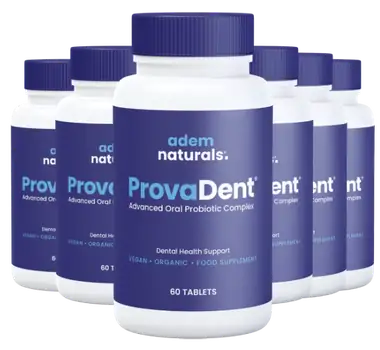
6 Bottles · 180-Day Supply
$49 / bottle
- ✓ Lowest price per bottle + 2 free bonuses
- ✓ 60-day money-back guarantee
- ✓ Free US shipping
Total: $294 + free shipping
Prices and package details shown are pulled from currently available marketing sources and can change — click any package above to see live current pricing on the official order page.
What “Working” Would Even Mean Here
Before getting into the evidence, it’s worth being precise about what ProvaDent is claiming. It isn’t claiming to cure gum disease, regrow enamel, or replace a dentist. The actual claims on the order page are more modest: supporting a balanced oral microbiome, promoting fresher breath, and supporting oral hygiene as part of a broader routine. Judged against those specific, narrower claims — not against an exaggerated version nobody actually promised — the picture is more nuanced than either “total scam” or “miracle fix.”
The Ingredient That Has the Strongest Case: Xylitol
Of everything in the ProvaDent formula, organic xylitol has the most independently published research behind it for exactly the use case ProvaDent is selling. Xylitol is a sugar alcohol that certain cavity-causing bacteria, most notably Streptococcus mutans, can’t metabolize the way they metabolize regular sugar. Multiple independent studies — conducted well outside of and long before ProvaDent existed as a product — have looked at xylitol’s role in reducing the bacterial load associated with cavities and plaque formation, which is exactly why it’s a standard ingredient in sugar-free gum and toothpaste marketed for oral health.
This doesn’t mean ProvaDent’s specific dose of xylitol has been clinically tested as part of this exact formula — it hasn’t, as far as we could find. But it does mean the underlying mechanism isn’t invented marketing language; it’s grounded in a real, separately verifiable body of dental research.
The Weakest Link: Undisclosed Probiotic Strains
This is where “does ProvaDent work” gets harder to answer with confidence. The order page states the product contains “4 strains of probiotics” but does not name which strains, at what CFU (colony-forming unit) count, or cite research specific to those strains for oral health.
This matters more than it might sound like. Probiotic research is highly strain-specific — a bacterial strain studied and shown effective for gut health doesn’t automatically carry over benefits to the mouth, and even within oral-probiotic research, different strains (like specific Lactobacillus or Streptococcus salivarius strains used in some competing products) have very different levels of supporting evidence. Without knowing which strains ProvaDent actually uses, there’s no way for an outside reviewer — or a buyer — to check that claim against the published literature. This is the single biggest transparency gap in the entire formula, and it’s the main reason we can’t give a confident “yes, the probiotic component is proven to work” answer.
The Supporting Cast: Cranberry Extract and Purple Carrot Powder
Cranberry extract has a real, if smaller, body of research behind its ability to interfere with how certain bacteria adhere to surfaces — most of that research focuses on urinary tract health, with a narrower set of studies looking specifically at oral bacterial adhesion and plaque. ProvaDent doesn’t disclose the extract’s concentration, so we can’t confirm the amount used matches what’s been studied, but the ingredient itself isn’t a stretch to include in an oral-health formula.
Purple carrot powder is presented mostly as a general nutritional addition rather than a targeted oral-health active ingredient — the order page’s own language (“contributes to your overall well-being”) is notably vaguer than the claims made for the other ingredients, which is itself informative: it suggests this component is doing less specific work in the formula than xylitol or the probiotic blend.
What ProvaDent Doesn’t Have: A Clinical Trial on the Finished Product
This is worth stating plainly because it applies to the large majority of supplements in this category, not just ProvaDent: we could not find a published, peer-reviewed clinical trial testing the complete ProvaDent formula, at its actual dosages, on real study participants. What exists is ingredient-level research on some (not all) of the components, conducted independently of ProvaDent as a brand.
That’s a meaningfully different, weaker form of evidence than a finished-product trial would be, and it’s the same gap present in most comparable oral-probiotic supplements on the market, including better-known competitors. If a company claims their exact formula was “clinically proven,” that’s a claim worth double-checking against an actual published study — and in ProvaDent’s case, we didn’t find one to check against.
Is ProvaDent Legit, or Is It a Scam?
These are two different questions that often get conflated. On legitimacy: ProvaDent is a real, purchasable product from a company (Adem Naturals) selling through ClickBank, a long-established digital retailer, with a stated 60-day money-back guarantee applying to every package size. That’s consistent with a legitimate, if aggressively marketed, supplement business — not the hallmarks of an outright scam, which typically involve no real product, no refund mechanism, or undisclosed recurring charges.
On the more precise question of whether the marketing overstates the evidence: yes, somewhat. The undisclosed probiotic strains, the proprietary “BioFresh Clean Complex” that hides its actual ingredient list, the unverified “As Seen On” media claim, and the absence of a finished-product clinical trial are all real gaps between the confident tone of the sales page and what can actually be independently verified. Legitimate and imperfectly transparent aren’t mutually exclusive, and ProvaDent lands in that combination.
What the Broader Oral-Probiotic Research Actually Shows
Stepping back from ProvaDent specifically, it’s worth understanding what independent, ProvaDent-unaffiliated research says about oral probiotics as a category, since that context shapes how much weight to put on any one product’s claims. A growing but still relatively young body of dental research has looked at specific probiotic strains — most notably certain Lactobacillus reuteri and Streptococcus salivarius strains (including the well-studied BLIS K12 and M18 strains used in some competing products) — for outcomes like reduced gingival bleeding, lower levels of odor-causing volatile sulfur compounds, and modest reductions in plaque scores over several weeks of daily use.
The key caveat dentists and researchers consistently raise is that these effects are generally modest, strain-specific, and most pronounced as a complement to standard oral hygiene — not a replacement for it. A 2022 review of oral probiotic trials in the dental literature found effects on gingivitis and plaque that were statistically significant in several trials but modest in absolute magnitude, and noted that study quality and strain selection varied widely across the research. That’s the honest baseline expectation for this entire product category, not just for ProvaDent: plausible, incremental support, not a dramatic standalone fix.
Because ProvaDent doesn’t disclose which strains its “4 strains of probiotics” actually are, there’s no way to check whether they overlap with the better-studied strains named above, or whether they’re a different, less-researched selection. That uncertainty is the central reason a confident “yes, it works” answer isn’t available — not because the underlying category is bunk, but because this specific product’s disclosure doesn’t let you verify where it falls within that category’s range of evidence quality.
What Dentists Generally Say About Probiotic Supplements
Most dental professionals who’ve weighed in publicly on oral probiotics take a measured position: they’re generally regarded as low-risk to try for people with mild symptoms, they’re not considered a substitute for professional cleanings or treatment of diagnosed gum disease, and their effectiveness is considered strain- and formulation-dependent rather than guaranteed across the category. That professional framing lines up with how we’d suggest treating ProvaDent specifically — worth trying if your expectations are calibrated to “possible modest support,” not worth relying on if you have a diagnosed dental condition that needs professional treatment.
Getting the Most Out of ProvaDent If You Try It
If you decide to test ProvaDent for yourself, a few practical points can help you judge results fairly rather than giving up (or declaring success) too early. First, commit to the full daily serving consistently — two tablets per day per the label — since inconsistent use makes it harder to attribute any change to the product specifically. Second, don’t stop brushing, flossing, or your regular dental visits; ProvaDent is positioned as a complement to those habits, and the ingredient research it’s drawing on (particularly for xylitol) assumes it’s layered on top of normal hygiene, not replacing it.
Third, give it a realistic runway before judging results. Because there’s no published timeline from a finished-product trial, and because the broader research on oral microbiome shifts generally points to several weeks of consistent use before changes become noticeable, a single 30-day bottle may not be enough time to fairly evaluate whether it’s doing anything for you — which is part of why the 60-day guarantee on the larger bundles is worth factoring into your decision if you want a genuine trial period without financial risk. Finally, track something concrete — how your gums look after brushing, whether your breath holds up longer between brushings — rather than relying purely on a general impression, since subtle improvements are easy to miss without a specific point of comparison.
What Would Make Us More Confident It Works
If Adem Naturals disclosed the specific probiotic strains and CFU counts, broke down the BioFresh Clean Complex into its actual components and dosages, and published even a small pilot study on the finished formula, this would move from “plausible mechanism, partially unverifiable” to a much stronger evidence case. None of those three things are present today, which is the honest reason we can’t rate the probiotic half of the formula with the same confidence as the xylitol half.
Realistic Expectations If You Try It
Based on the ingredient profile, the most realistic outcome for someone with mild, early symptoms — occasional bleeding gums, some sensitivity, breath that fades quickly after brushing — is a gradual, moderate improvement over several weeks, primarily driven by the xylitol component and general improved routine adherence that often comes with any new health product people are motivated to stick with. It is not a realistic expectation that ProvaDent will resolve diagnosed periodontal disease, reverse gum recession, or replace professional dental treatment, and the product’s own disclaimer says as much.
How ProvaDent Compares to Just Using Mouthwash or Sugar-Free Gum
Since xylitol is ProvaDent’s best-evidenced ingredient, and xylitol is also available cheaply in sugar-free gum and some mouthwashes, it’s a fair question whether a $69-plus supplement adds anything beyond what a pack of xylitol gum already offers. The honest answer is: partially. ProvaDent bundles xylitol with several other ingredients (cranberry extract, the undisclosed probiotic strains, purple carrot powder) that aren’t present in a typical stick of gum, so it’s a different, broader-spectrum product rather than a pure xylitol delivery method. Whether that broader formula outperforms a much cheaper xylitol gum habit isn’t something we can verify without disclosed strain and dosage data — but it’s a reasonable, low-cost comparison to keep in mind if budget is a concern and you mainly want the xylitol benefit specifically.
Where ProvaDent’s format may have a practical edge is consistency and habit-forming simplicity: a single daily supplement routine (two tablets) is arguably easier for some people to stick with consistently than remembering to chew xylitol gum multiple times after meals, which is the dosing pattern most xylitol research is actually based on. If adherence is your biggest obstacle to any oral-health routine, that convenience factor is worth something, even though it isn’t a claim ProvaDent’s own marketing makes explicitly.
Red Flags to Watch For (And What We Didn’t Find)
When evaluating any supplement in this category, a few warning signs are worth checking for: hidden recurring subscription charges, no disclosed guarantee, no way to contact the company, or claims of curing diagnosed disease. We did not find evidence of hidden subscription billing on the ProvaDent order page — the pricing displayed appears to be a one-time purchase per package size — and the 60-day guarantee is clearly stated. The disclaimer language on the order page also appropriately avoids claiming to diagnose, treat, cure, or prevent disease, which is a legally required disclosure for supplements and a good sign that the marketing stays within standard industry bounds rather than making illegal medical claims.
The legitimate concerns we did find — undisclosed probiotic strains, an unbroken-down proprietary blend, an unverified media-mentions claim, and no finished-product clinical trial — are transparency gaps rather than red flags indicating fraud. That distinction matters: a product can be honestly sold and still under-disclose information that would help you make a fully informed decision, and that’s the category ProvaDent falls into based on our research.
Frequently Asked Questions
Does ProvaDent really work for bad breath?
Xylitol has real research behind reducing the bacteria associated with bad breath, so there’s a plausible mechanism. Without disclosed probiotic strain data, we can’t fully verify the probiotic component’s specific contribution to breath freshness beyond that mechanism.
Is ProvaDent backed by any clinical studies?
We did not find a published clinical trial on the finished ProvaDent formula. Some individual ingredients, particularly xylitol, have independent research behind them for related oral-health purposes.
How long does it take to see results?
ProvaDent doesn’t publish a specific results timeline, and no finished-product trial exists to establish one. General oral-microbiome shifts are typically described in the broader research literature as taking several weeks of consistent use to become noticeable, which is one reason the 3- and 6-bottle packages may make more practical sense than a single-bottle trial if you intend to give it a fair test.
What's good
- Xylitol and cranberry extract both have real, independently published research behind their oral-health mechanisms
- 60-day money-back guarantee applies to every package size, including the single bottle
- Manufactured in an FDA-registered, GMP-certified U.S. facility, and described as non-habit forming
- Chewable tablet format gives direct contact with teeth and gums during use, not just systemic absorption
- Lower single-bottle entry price ($69) than several competing oral-probiotic brands
Limitations
- The 4 probiotic strains are not named and no CFU (colony-forming-unit) count is disclosed
- The proprietary BioFresh Clean Complex has no ingredient-by-ingredient breakdown
- No published clinical trial on the finished ProvaDent formula itself, only on some individual ingredients
- Limited independent, non-manufacturer review history available at the time of writing
- The order page As Seen On media claim could not be independently verified
Our Overall Confidence Rating
Weighing everything above, here’s how we’d break down our confidence level ingredient by ingredient: high confidence in xylitol’s relevance to the claimed benefits, based on independent research; moderate confidence in cranberry extract’s contribution, based on a smaller but real research base; low confidence — not because it’s disproven, but because it’s undisclosed — in the specific probiotic strains, which is the ingredient category doing the most marketing work in ProvaDent’s pitch; and minimal claimed role for purple carrot powder beyond general nutrition. None of that adds up to “clinically proven,” and none of it adds up to “doesn’t work” either — it lands in the more common, less exciting middle ground most supplements in this category actually occupy.
Bottom Line: Does ProvaDent Work?
Partially, and unevenly, based on the available evidence. The xylitol component is genuinely well-supported for the exact purpose ProvaDent is marketed for. The probiotic strains — arguably the headline ingredient — are undisclosed, which makes that part of the claim unverifiable rather than proven or disproven. Cranberry extract has modest supporting research; purple carrot powder appears to be more of a nutritional add-on than a core active ingredient. There’s no clinical trial on the finished product itself.
If you go in with realistic, evidence-calibrated expectations — a plausible, partially-supported supplement worth trying at low financial risk thanks to the 60-day guarantee, rather than a clinically proven cure — ProvaDent is a reasonable thing to test for yourself. For the full pricing breakdown, ingredient-by-ingredient analysis, and package options, see our complete ProvaDent review, where we also cover the guarantee terms and customer feedback in more detail.
Disclosure: This article contains affiliate links. If you purchase ProvaDent through a link on this page, The Health Primer may earn a commission at no additional cost to you.