Kerassentials Ingredients Explained: All 17 on the Label and What the Evidence Really Says
The Kerassentials ingredients list has 17 items: one active-sounding compound (undecylenic acid, stated at 5%), seven carrier oils, six aromatic oils, menthol, aloe vera leaf extract and vitamin E acetate. Only the undecylenic acid has a percentage on the label. The other 16 ingredients have no disclosed amounts, and we found no published trial of the finished product on human nails. That is the short answer, and the rest of this guide explains what each ingredient is, what the evidence does and does not show, and how transparent the formula really is.
If you are comparing this oil with other options, our full Kerassentials review covers the brand, the claims and the buying process. Here we stay on the label itself: all 17 ingredients in label order, a plain-language role for each, and a careful split between lab-dish findings and actual nail results. Kerassentials is marketed for nail and skin support, and nothing below should be read as a claim that it treats or cures nail fungus.

2 Bottles · 60-Day Supply
$79 / bottle
- ✓ Basic package at the standard per-bottle rate
- ✓ 60-day money-back guarantee
- ✓ One-time payment, no subscription
Total: $158 + $9.99 shipping

3 Bottles · 90-Day Supply
$69 / bottle
- ✓ Save $10/bottle vs. the 2-bottle rate
- ✓ 60-day money-back guarantee
- ✓ Free US shipping, one-time payment
Total: $207 + free US shipping

6 Bottles · 180-Day Supply
$49 / bottle
- ✓ Save $30/bottle vs. the 2-bottle rate, plus 3 bonus guides
- ✓ 60-day money-back guarantee
- ✓ Free US shipping, one-time payment
Total: $294 + free US shipping
Prices and package details shown were taken from the official order page when we checked and can change — click any package above to see live current pricing.
- Basic — 2 bottles (60-day supply): $79 per bottle, $158 total plus $9.99 shipping.
- Most Popular — 3 bottles (90-day supply): $69 per bottle, $207 total with free US shipping and a “surprise gift.”
- Best Value — 6 bottles (180-day supply): $49 per bottle, $294 total with free US shipping, three bonus guides and a “surprise gift.”
Every package is a one-time payment, not a subscription, and is covered by a 60-day money-back guarantee. The honest saving from the smallest package to the largest is $30 per bottle ($79 down to $49). The vendor also shows much higher crossed-out “regular” prices, but we could not verify that anyone has ever paid them, so we do not treat them as a real discount. Prices can change, so check the official order page before you buy.
What Are the Kerassentials Ingredients? The Full Label, All 17
This is the label as we have it, in label order. In most countries, ingredients on supplements and cosmetics are listed from the largest amount to the smallest, but because only one percentage is disclosed, we cannot confirm the actual proportions. Treat the order as a hint, not a measurement. The “evidence note” column is our own summary of general background, not a finding about this product.
| # | Ingredient | Likely role | Evidence note |
|---|---|---|---|
| 1 | Undecylenic Acid USP (5%) | Antifungal fatty acid | Used in OTC skin products; not nail-specific |
| 2 | Mineral Oil | Carrier / moisture barrier | Inert emollient; no antifungal role |
| 3 | Sweet Almond Oil | Carrier, conditioning | Moisturizer; tree-nut allergen |
| 4 | Organic Flaxseed Oil | Carrier, conditioning | Emollient; no nail-fungus data we could verify |
| 5 | Tea Tree Oil (Melaleuca alternifolia) | Aromatic with lab antifungal activity | Lab data plus one small older human trial (pure oil) |
| 6 | Aloe Vera Leaf Extract | Soothing / skin-feel | Skin-soothing reputation; not a proven nail antifungal |
| 7 | Canola Oil | Carrier | Cooking-type oil used as a base |
| 8 | Tocopheryl Acetate (vitamin E) | Antioxidant / preservative / skin conditioner | Common cosmetic ingredient; not antifungal |
| 9 | Walnut Oil | Carrier | Emollient; tree-nut allergen |
| 10 | Menthol | Cooling sensation / scent | Sensory ingredient; can irritate |
| 11 | Camphor (Cinnamomum camphora oil) | Aromatic / counter-irritant | Sensory; caution for small children and large areas |
| 12 | Clove Bud Oil | Aromatic with lab antimicrobial activity | Lab data only, as far as we could verify; known skin irritant |
| 13 | Jojoba Oil | Carrier (a liquid wax) | Emollient; no antifungal role |
| 14 | Chia Oil | Carrier | Emollient; no nail-fungus data we could verify |
| 15 | Lemongrass Oil | Aromatic with lab antifungal activity | Lab data; a known sensitizer for some people |
| 16 | Lavender Oil | Aromatic / scent | Some lab data; also a possible contact allergen |
| 17 | Manuka Oil | Aromatic | Mostly lab-level interest; little human nail data we could verify |
A quick way to read the table: 7 carrier oils (rows 2, 3, 4, 7, 9, 13, 14) make up the base; 6 aromatic oils plus menthol (rows 5, 10, 11, 12, 15, 16, 17) supply scent, sensation and lab-level antimicrobial interest; and the remaining three (undecylenic acid, aloe extract, vitamin E acetate) have more specific jobs. The vendor’s own page highlights eight of the 17: lavender, flaxseed, almond, tea tree, lemongrass, aloe vera, tocopheryl acetate and undecylenic acid. Words like “non-GMO” come from the vendor, and we could not verify them.
Is 5% Undecylenic Acid Enough? How It Compares With Typical OTC Strengths
Undecylenic acid is the ingredient most people mean when they ask what is “active” in Kerassentials. It is a fatty acid derived from castor oil and has long been used in over-the-counter products for skin infections such as athlete’s foot and ringworm. It is also the only ingredient with a disclosed percentage: 5%.
Here is the context that matters. OTC skin products containing undecylenic acid commonly use higher strengths, often cited somewhere around 10% to 25%, though you should check any specific product label rather than rely on that range. Those products are labeled for skin, not for the thick nail plate. So a 5% concentration is lower than what is commonly seen in skin products, and we could not find any published data on how 5% performs on nails when delivered in this particular oil base.
- What 5% does tell you: the vendor is willing to state one number, and the compound is a recognized one (the “USP” on the label refers to a pharmacopeial quality standard).
- What 5% does not tell you: whether enough of it reaches the infection, which sits in and under the nail. Penetration through a hard nail plate is the central difficulty of every topical treatment.
- What it cannot be compared with: prescription nail topicals, which are formulated and tested specifically for nail penetration (more on that below).
The lower strength may be partly a tolerability choice, since the formula also includes several irritating aromatics and is applied four times a day. But that is our reading, not something the vendor explains. The practical takeaway is simple: do not assume that “contains undecylenic acid” means “performs like a proven nail antifungal.”
What Do the Carrier Oils Actually Do?
Seven of the 17 ingredients are carrier oils: mineral oil, sweet almond oil, flaxseed oil, canola oil, walnut oil, jojoba oil and chia oil. Together they most likely make up the bulk of the liquid in the bottle. A carrier oil’s job is to dilute stronger ingredients so they can be brushed on, spread them over the nail and surrounding skin, and keep the skin around the nail from drying out.
That is a legitimate function. Dry, cracked nails and cuticles are uncomfortable, and a conditioning oil can improve how nails and surrounding skin look and feel. But conditioning is not the same as clearing an infection, and we found no evidence that any of these seven oils has meaningful activity against the fungi that cause toenail onychomycosis when used as a topical on the nail.
- Mineral oil is a refined petroleum-derived emollient. It is widely used in skin products and is not an antifungal. It also sits oddly against the vendor’s “no chemicals” style of messaging, because mineral oil is, in plain terms, a chemical product, as is undecylenic acid. Almost everything is a chemical; the phrase tells you little.
- Sweet almond oil and walnut oil are tree-nut oils. People with tree-nut allergy should check with a doctor first, because the label does not say whether the oils are refined.
- Flaxseed, chia and canola oils are plant oils that are commonly marketed for their fatty acid content. As topicals on a nail, they are best understood as moisturizing bases.
- Jojoba oil is technically a liquid wax, often used in skin care because it spreads well and is generally gentle.
One more practical point: plant oils such as flaxseed can go rancid over time. We do not know the formula’s preservation system beyond the vitamin E acetate on the label, so store the bottle as directed and stop using it if it smells off.
Tea Tree and the Other Essential Oils: What Is Known?
This is the group the vendor leans on, and the one where lab findings are easiest to over-read. The aromatic oils are tea tree (Melaleuca alternifolia), clove bud, camphor (Cinnamomum camphora), lemongrass, lavender and manuka.
Tea tree oil: the one with a human nail trial
Tea tree oil is the best-studied ingredient in the group. In laboratory work it shows activity against several fungi and yeasts. In people, the often-cited study is a randomized trial by Buck and colleagues (Journal of Family Practice, 1994) in 117 patients with culture-confirmed distal subungual onychomycosis. Participants applied either 1% clotrimazole solution or 100% tea tree oil twice daily for six months. Culture cure was roughly 11% with clotrimazole and 18% with tea tree oil, and partial or full clinical improvement was about 60% in both groups at six months. Recurrence was high with every treatment.
Read that carefully. It was a single, modest, older study. It used pure, undiluted tea tree oil, which is not what is in this bottle, where tea tree is one of 17 ingredients at an undisclosed amount. And the comparison drug was a weak one. The study tells us tea tree oil is not nonsense; it does not tell us that a diluted blend works.
Clove, lemongrass, lavender, manuka and camphor
Clove bud oil, lemongrass oil and others have shown antimicrobial or antifungal activity in laboratory studies, usually in test tubes or petri dishes at defined concentrations. As far as we could verify, there are no comparable randomized nail trials for these oils as used in this product. Lavender is better known for scent and skin-soothing claims, and manuka oil is mainly of laboratory interest. Camphor is generally included for its aroma and warming-cooling skin effect rather than as a proven antifungal.
The key distinction is between “active in a dish” and “clears a nail.” A substance can kill fungus on a plate and still do nothing for an infection protected by a keratin plate, especially at low concentrations and mixed in a carrier oil.
What Do Menthol, Aloe Vera and Vitamin E Add?
Menthol and camphor are sensory ingredients. Menthol gives a cooling feel and camphor a distinctive medicinal smell and mild warming-cooling sensation. Neither is an established nail antifungal. They may make the product feel “active,” which is a marketing reality worth noticing: a tingle is not evidence of efficacy. Both can irritate skin, and camphor and menthol can be hazardous on large areas of skin or around small children, so this is a product to keep out of reach of kids.
Aloe vera leaf extract is mainly there for its soothing, skin-friendly reputation. Aloe in a small amount of oil is not the same as fresh gel, and we do not know how much is present. It is reasonable as a comfort ingredient for skin around the nail. We found nothing to show it clears nail infection.
Tocopheryl acetate is the stable, esterified form of vitamin E, widely used in cosmetics as a skin conditioner and to help protect oils from oxidation. It is a supporting ingredient, not a treatment.
Taken together, the second half of the label reads like a well-worn natural-skin-care recipe: soothing, scenting and conditioning. That is not an insult; it just means the science-based claims rest on a few of the ingredients, not on all 17.
Which Kerassentials Ingredients Have Lab Data and Which Have Human Nail Data?
This is the part most ingredient pages blur. Here is a cautious sorting, using the three levels of evidence that matter for a nail product.
- Human data on nails (treated with the ingredient alone): tea tree oil, from the small 1994 trial of pure oil described above. Undecylenic acid has a long history in OTC skin products, but we did not find nail-specific trial data we could rely on.
- Lab data on fungi (in a dish): tea tree, clove bud, lemongrass, lavender and some other essential oils; undecylenic acid is also an antifungal compound in laboratory and skin-use contexts.
- Conditioning or sensory role only: the seven carrier oils, aloe extract, vitamin E acetate, menthol and camphor.
- Human data on the finished Kerassentials product: none that we could find. The vendor’s reference list consists of studies on single ingredients and laboratory antifungal activity.
The last bullet is the one to remember. The ingredient references show that some components are biologically interesting. They do not show that the 17-ingredient mixture, at its undisclosed proportions, works on a toenail. Combining ingredients can change how well each one is absorbed, how irritating the mix is, and how much of any active reaches the infection. A blend needs to be tested as a blend. For a wider look at that question, see our guide on whether Kerassentials works.
What Is Missing From the Kerassentials Label?
Judging a formula often means noticing what is absent as much as what is listed.
- No concentrations for 16 of 17 ingredients. We know undecylenic acid is 5%. We do not know whether tea tree is 1% or 20% of the bottle, or whether the menthol is a trace or a meaningful amount. Those proportions decide both effectiveness and irritation risk.
- No testing on the finished product. We found no published clinical trial, and no independent laboratory report showing the blend’s effect on nail fungus or on how much active ingredient penetrates a nail.
- No named manufacturer or facility. The label says the product is distributed by Kerassentials in Aurora, Colorado. The vendor’s wording about being made in an “FDA accredited” facility is not something we can verify; the FDA registers facilities rather than accrediting them, and the facility is not named.
- No stated preservation system or refinement level for the oils. That matters mostly to people with nut allergy and to anyone worried about shelf life.
- No nail-specific penetration data. Nothing we found explains how the blend crosses the nail plate, beyond the instruction to lightly file the nail surface to improve absorption.
None of this proves the product is useless. It means the buyer has to take much of the story on trust, which is a poor position for a product that costs from $49 to $79 per bottle.
How Does the Formula Compare With Proven Nail Topicals?
The best independent evidence on topical nail treatments is a Cochrane review (Foley and colleagues, 2020) that pooled 56 randomized trials with 12,501 participants with toenail onychomycosis, looking at topical and device treatments. It did not include essential-oil blends among its key comparisons. Its main findings are useful anchors.
| Topical | Access | What the evidence suggests |
|---|---|---|
| Efinaconazole 10% | Prescription | High-quality evidence of benefit for complete cure (risk ratio roughly 3.5 versus vehicle) |
| Tavaborole 5% | Prescription | Showed benefit, with lower-quality evidence |
| Ciclopirox 8% lacquer | Prescription | Showed benefit, with lower-quality evidence |
| Kerassentials (17-ingredient oil) | Sold online as a cosmetic-style product | No published trial of the finished product that we could find |
Two cautions come out of that review. First, even the best topicals have relatively low complete-cure rates, and most trials ran 48 to 52 weeks. Second, local skin reactions were more common with some active drugs, so “proven” does not mean “effortless.” Oral prescription antifungals such as terbinafine generally outperform topicals but need a doctor because of liver and drug-interaction considerations.
All three proven topicals are prescription items with defined concentrations, tested in the form that is sold. Kerassentials is the opposite on each point: no prescription, one disclosed percentage, and no finished-product trial. That does not make it dangerous or pointless; it places it firmly in the “unproven” category, which is where any buyer should keep it mentally.
Are Any Kerassentials Ingredients Allergens or Irritants?
For a blend with six aromatic oils and menthol, the answer is yes, for some people. Tea tree, clove, lemongrass, lavender, camphor and menthol are all recognized contact allergens or irritants in a minority of users. Almond and walnut oils matter for anyone with a tree-nut allergy. We keep the detail short here and cover it fully in our guide to Kerassentials side effects, but the essentials are:
- Patch-test first on a small area of skin and wait before applying to the nail and cuticles.
- Keep it away from eyes, mucous membranes and broken skin. The label says for external use only, and to discontinue if irritation occurs.
- Never swallow it. Tea tree oil is toxic if ingested, and the label advises seeking medical attention if swallowed.
- Keep it from children and pets. Ask a doctor first if you are pregnant or nursing, or if a child would use it.
- Nut allergy: the label does not say whether the almond and walnut oils are refined, so ask a doctor before using it.
Because the directions call for application four times a day, plus filing the nail surface, there is more opportunity for irritation than with a once-daily product. Redness, itching, swelling or pain around the nail means stop and see a clinician. Pain, swelling or redness could also signal a bacterial infection rather than fungus.
Is the Kerassentials Formula Transparent? Our Plain-Language Verdict
We would call it partly transparent. In its favor, the vendor does list all 17 ingredients, names the botanical species for tea tree and camphor, specifies “USP” grade for the undecylenic acid, and states that one percentage. That is more disclosure than many “proprietary blend” supplements provide.
Against that:
- 16 of 17 ingredients have no amounts, so you cannot judge dose, strength or irritation risk.
- The ingredient references the vendor cites focus on single ingredients and lab activity, not on the product.
- Some marketing language does not line up with the legal disclaimer. Wording about killing fungus sits beside a standard “not evaluated by the FDA, not intended to diagnose, treat, cure or prevent any disease” statement.
- The manufacturer and facility are not named, and the “FDA accredited” phrase does not match how FDA registration works.
- Review counts and testimonials on the vendor’s page, such as a “based on 14,576 reviews” figure, cannot be verified independently.
So the label is open about what is in the bottle but quiet about how much and whether it works as a mixture. If you are wondering whether the wider marketing is a red flag, our piece on whether Kerassentials is a scam takes that up fairly.
How Long Would You Need to Use It, and What Does the Guarantee Cover?
The vendor says to expect results after roughly 9 to 12 weeks and recommends at least three bottles and about three months before judging. Directions are to apply four times daily (twice in the morning, twice in the afternoon), brushing it onto the nail, working it into the cuticle area with a cotton swab, and lightly filing the nail surface with an emery board first.
A nail takes about 6 to 12 months or more to grow out, and most nail-treatment trials run 48 to 52 weeks. The 60-day guarantee, measured from delivery, is therefore shorter than the time needed to see whether a nail is truly clearing. To claim it you email a “Refund Request” to support and send back all bottles, empty or not, at your own cost to the Aurora, Colorado address. Refunds are processed within a few days of receipt and can take 5 to 10 days to show on a card. The vendor’s FAQ says “no questions asked,” yet the policy requires returning every bottle, so plan for that. Orders are handled through ClickBank (support line 1-800-390-6035), and the card statement reads “CLKBANK*Kerassentials.” The official site is the only place the vendor says it sells; several third-party review pages mention counterfeit or lookalike bottles on marketplaces such as Amazon and eBay, which we cannot verify but is a reason to be careful.
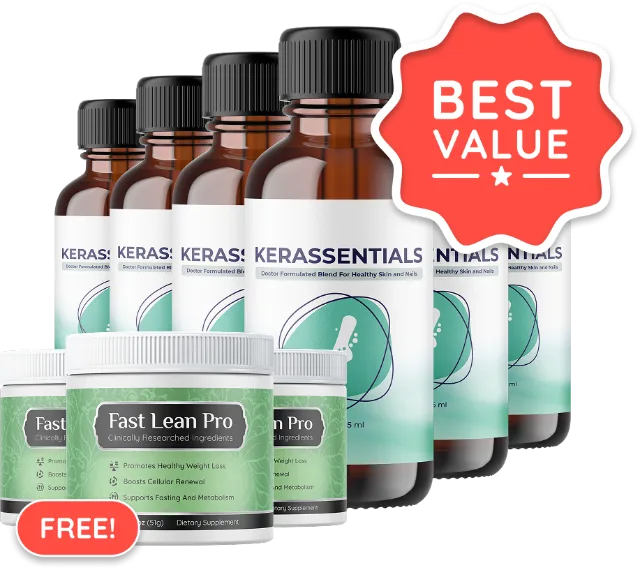
One more point on packages: the artwork shows free jars labeled “Fast Lean Pro” as the apparent “surprise gift.” We have not evaluated that product and have no ingredient information for it, so we do not factor it into this assessment. The three bonus guides (Skin SOS, Barefoot Ready and The Fungal Full Detox Plan) carry vendor-claimed values that we could not verify.
What Should You Do Before Buying a Nail Oil?
Not every thick or discolored nail is fungus. Psoriasis, injury and lichen planus can all mimic it, which is why a clinician, ideally with a lab test, is worth seeing before you spend money. A short checklist:
- Get a diagnosis, particularly if the nail is painful, swollen or red.
- If you have diabetes, poor circulation or an immune problem, see a clinician before trying any home treatment on the feet.
- Ask a podiatrist or dermatologist about prescription topicals or oral options, which have the strongest evidence.
- Keep feet dry, rotate shoes, clip nails straight across and do not share clippers, since recurrence is common whatever you use.
- If you do try Kerassentials, patch-test, set a calendar reminder before the 60-day window closes, and photograph the nail at the start to track any change objectively.
Frequently Asked Questions
How many ingredients are in Kerassentials?
The label lists 17: undecylenic acid (5%), mineral oil, sweet almond oil, organic flaxseed oil, tea tree oil, aloe vera leaf extract, canola oil, tocopheryl acetate, walnut oil, menthol, camphor oil, clove bud oil, jojoba oil, chia oil, lemongrass oil, lavender oil and manuka oil.
What is the main active ingredient in Kerassentials?
Undecylenic acid at 5% is the only ingredient with a stated percentage and is the closest thing to a labeled active. Tea tree oil is the other ingredient with the most research behind it, but the vendor does not disclose how much is in the bottle.
Is 5% undecylenic acid strong enough for nail fungus?
We could not find data showing it is. Over-the-counter skin products commonly use higher strengths, and those are labeled for skin rather than nails. Prescription nail topicals are tested specifically for nails.
Does tea tree oil treat toenail fungus?
A small 1994 randomized trial of 100% tea tree oil found partial or full clinical improvement in about 60% of participants at six months, but culture cure was only about 18%, and recurrence was high. That was pure oil in one modest study, so it does not prove a diluted blend works.
Are the ingredients natural and safe?
The vendor markets the blend as natural, but natural does not mean non-irritating. Several of the aromatic oils are known contact allergens for some people, and almond and walnut oils matter for tree-nut allergy. Patch-test first and stop if irritation develops.
Does Kerassentials contain anything that needs a prescription?
Not based on the label. It lists no prescription antifungal such as efinaconazole, ciclopirox or tavaborole, which are the ones with the strongest topical evidence.
Can I use Kerassentials if I am allergic to nuts?
The formula contains sweet almond oil and walnut oil, and the label does not say whether they are refined. Ask your doctor before using it.
Where are the ingredients made?
The label names only the distributor (Kerassentials, Aurora, Colorado). We could not find a named manufacturer or facility.
Our Take
The Kerassentials ingredient list is a reasonable-looking natural oil blend: a recognized antifungal fatty acid at 5%, tea tree and other aromatic oils with laboratory interest, and a lot of conditioning carrier oils. What it lacks is proof that the combination, at its undisclosed proportions, does anything for nail fungus. The strongest evidence we found for topical nail treatment applies to prescription products, not to this one, and the vendor’s references do not test the finished bottle.
It may suit someone who wants a scented conditioning oil for dry nails and cuticles, has no nut allergy or sensitivity to aromatic oils, and understands that results are unproven. It is probably not a good fit for anyone with a painful, spreading or diabetic-related nail problem, anyone who is pregnant or nursing, or anyone who wants an evidence-backed treatment; those readers should see a doctor, podiatrist or dermatologist first.
If you do decide to try it, the 60-day guarantee limits the financial risk, but remember it requires returning every bottle and runs shorter than a full nail growth cycle. Confirm the price and shipping at checkout, since the vendor’s shipping page and the 2-bottle tier do not match exactly.
Related reading: Kerassentials review · Does Kerassentials work? · Kerassentials reviews and complaints · Is Kerassentials a scam? · Kerassentials side effects
Disclosure: we may earn a commission if you buy through our links, at no extra cost to you, and it does not change our assessment.